One reference page for importers, agronomists and translators: what alfalfa is called in 60 languages, why half the world says lucerne, and which tariff heading the seed and the hay travel under.
Alfalfa is the same plant in Riyadh, Tehran, Nairobi, Ankara, Buenos Aires and Beijing, but the word changes at every border, and the person who gets the word wrong loses the tender, the search result or the customs declaration. This page gives the name in the native script and in transliteration for 60 languages, explains the alfalfa-versus-lucerne split, settles the scientific name, and walks through HS code 1209.21 for seed and heading 1214 for hay and meal — written by a seed exporter that has shipped Medicago sativa seed from Pakistan since 1957.
WhatsApp +92 310 4929292 Get a quote in 24h
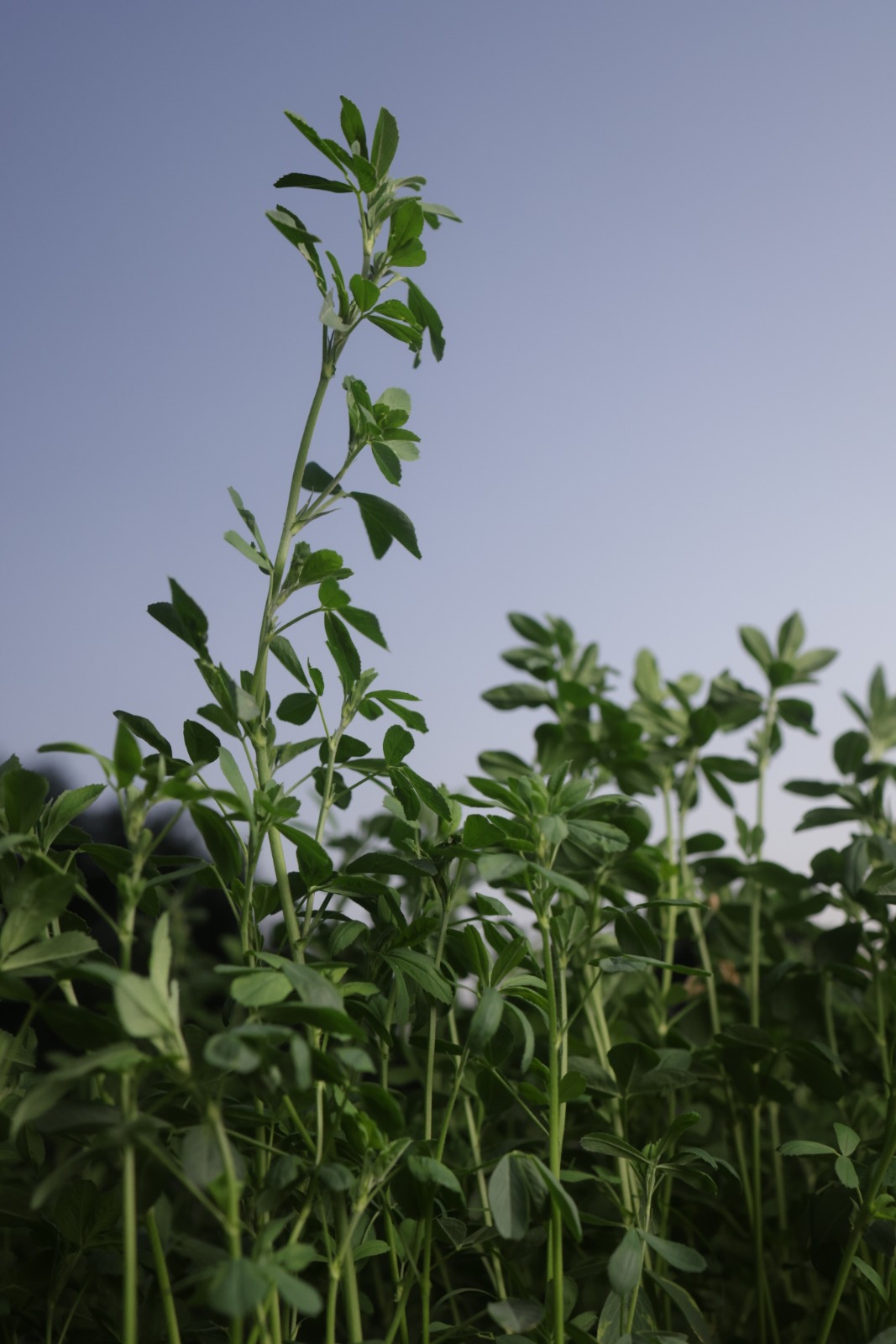
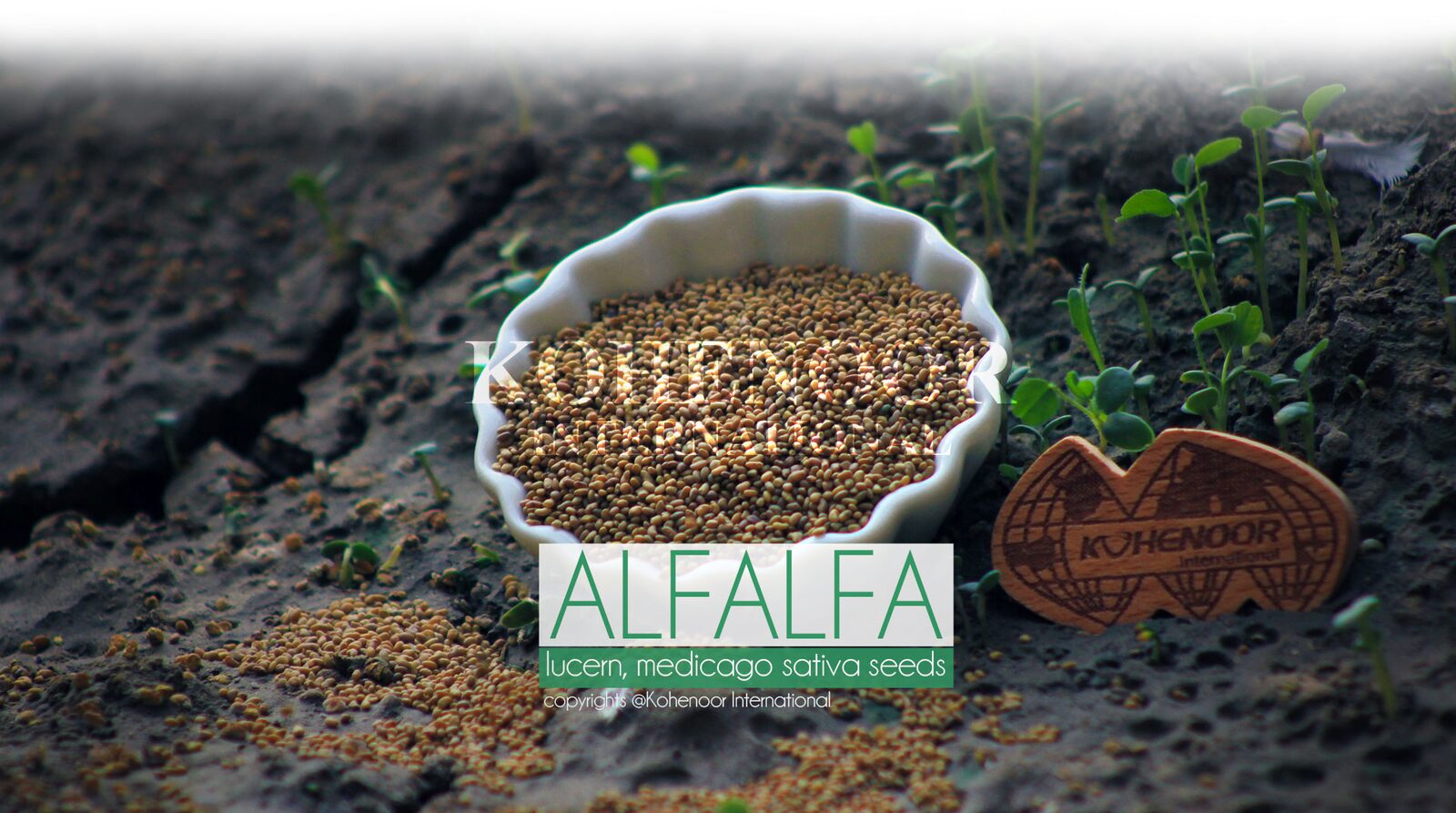
The scientific name of alfalfa is Medicago sativa L. — the “L.” marks Linnaeus, who described the species in 1753. It belongs to the legume family, Fabaceae (older texts write Leguminosae), subfamily Faboideae, in the same tribe as clovers and medics. That family membership is not a botanical footnote: it is the reason alfalfa fixes its own nitrogen through root nodules, the reason it carries 22–24% crude protein in the leaf, and the reason it is written into forage rotations from the Nile Delta to the Pampas.
The genus name Medicago comes from the Greek mēdikē, “the Median plant” — the Medes of ancient Persia. Classical writers recorded that the crop reached Greece from Media in the fifth century BCE, and the Italian name erba medica and the Greek μηδική still say “Median grass” two and a half thousand years later. Sativa simply means “cultivated”, as in Oryza sativa (rice) or Cannabis sativa, and distinguishes the sown crop from its wild relatives.
Within the species, agronomists recognise several subspecies. M. sativa subsp. sativa is the purple-flowered, upright plant that fills a hayfield; subsp. falcata is the yellow-flowered, very winter-hardy relative of the Eurasian steppe; and subsp. × varia is the hybrid between them, the source of much of the cold tolerance in northern cultivars. Cultivated alfalfa is an autotetraploid with 32 chromosomes, which is part of why a modern cultivar represents decades of selection rather than a single cross.
For a buyer, the practical upshot is this: whatever the label says — alfalfa, lucerne, yonca, 苜蓿 — the phytosanitary certificate, the ISTA Orange Certificate and the customs declaration will all carry Medicago sativa. It is the one name that does not need translating. When Kohenoor's export desk issues a Certificate of Analysis for a lot of TAIZTAR or KN92, the species line reads Medicago sativa whether the destination is Jeddah, Mombasa or Manila.
“Lucerne vs alfalfa” is one of the most common questions the export desk receives from first-time buyers, and the answer is that there is no botanical difference whatsoever. Both words name Medicago sativa. The split is purely linguistic and geographic.
Alfalfa entered English through Spanish. Spanish took it from Andalusian Arabic al-faṣfaṣa (الفصفصة), and the Arabic in turn goes back to a Persian word for the plant, aspast or ispist, which is also the ancestor of the Pashto spasta in the table below. The word travelled with the plant: Arab agronomists carried alfalfa across North Africa into Spain, Spanish colonists carried it to the Americas, and American agriculture carried the word into global seed trade in the twentieth century. Today “alfalfa” is the standard word in the United States, Canada, Mexico, all of Spanish-speaking South America, Brazil (as alfafa), in Japanese and Korean loanwords, and in most international seed catalogues, tariff schedules and scientific papers.
Lucerne entered English from French luzerne, which is usually traced to a Provençal word for a glow-worm, said to refer to the shiny seed — though dictionaries treat that origin as probable rather than certain. It is the word of Britain and the Commonwealth: the United Kingdom, Ireland, Australia, New Zealand, South Africa, and the agricultural English of Pakistan, Kenya, Zambia and much of anglophone Africa. It is also the root of the French, German, Dutch, Polish, Hungarian, Romanian, Russian, Scandinavian and Baltic names, which is why a European seed catalogue in any of those languages will look familiar once you know the pattern.
In practice the two words coexist inside single countries. A Pakistani farmer says lusan, writes “lucerne” on a tender and buys a bag labelled “alfalfa seed”. The Harmonized System itself hedges by writing “lucerne (alfalfa)” in the heading text. Our own site reflects the split: the Pakistan domestic pages at /pk/lucerne-alfalfa-beej/ lead with lucerne, the export pages lead with alfalfa, and the seed in the bag is identical.
One trap worth naming: in Egypt and Sudan the word barsīm on its own means Egyptian clover (Trifolium alexandrinum, berseem), not alfalfa — alfalfa is barsīm ḥijāzī, “Hijazi clover”. Likewise shaftal in Persian and Urdu is Persian clover (T. resupinatum), not alfalfa. When a specification matters, write Medicago sativa next to whatever common name you use.
The table below lists the name for alfalfa in 60 languages and regional varieties, with native script where the language does not use the Latin alphabet, a transliteration, and a short note on where the word is used and what to watch for. It is organised roughly by region: the Arabic-speaking world, then Persian and Turkic Central Asia, East and South-East Asia, South Asia, Europe, and Africa. Entries marked “commonly” are everyday usages the desk hears from buyers and growers rather than dictionary forms; where a language has no settled native word, the international loanword is given because that is what seed shops and tenders in that country actually use.
| Language | Native script | Transliteration / Latin form | Where used and notes |
|---|---|---|---|
| English (US, Canada, trade) | alfalfa | alfalfa | The word used in North America, Latin America and in most international seed trade and customs texts |
| English (UK, Australia, NZ, South Africa) | lucerne | lucerne | The Commonwealth word; HS texts write “lucerne (alfalfa)” to cover both |
| Arabic — Egypt, Sudan, Levant | برسيم حجازي | barsīm ḥijāzī | Literally “Hijazi clover”; the name on most Egyptian and Sudanese tenders |
| Arabic — Gulf (Saudi, UAE, Kuwait, Qatar, Bahrain, Oman) | جت | jatt | The everyday Gulf word; green jatt is sold by the bundle in livestock markets |
| Arabic — Levant, Maghreb, Iraq | فصفصة | fiṣfiṣa | The classical form that gave Spanish and English the word “alfalfa” |
| Arabic — Yemen and parts of the Peninsula | قضب | qaḍb | Regional; commonly heard in Yemen and the south of Saudi Arabia |
| Persian (Iran) | یونجه | yonjeh | The standard word in Iran; Iran is one of the oldest alfalfa-growing regions on record |
| Dari (Afghanistan) | رشقه | rishqa | Afghan usage; yonjeh is also understood |
| Pashto | سپستا / رشقه | spasta / rishqa | Both heard; spasta is the older Pashto form (commonly) |
| Urdu (Pakistan) | لوسن | lusan | The farm word in Pakistan; “alfalfa” and “lucerne” are also used on seed bags |
| Punjabi (Pakistan, Shahmukhi) | لوسن | lusan | Same word as Urdu across the Punjab plains (commonly) |
| Turkish | yonca | yonca | Turkey is a major producer; “kaba yonca” is the specific name for Medicago sativa |
| Azerbaijani | yonca | yonca | Shares the Turkic root with Turkish |
| Turkmen | ýorunja | yorunja | Turkic form used in Turkmenistan |
| Kazakh | жоңышқа | zhongyshqa | Standard Kazakh; also written joñyşqa in the new Latin orthography |
| Kyrgyz | беде | bede | Shared with Uzbek and Uyghur |
| Uzbek | beda | beda | Latin script is official in Uzbekistan; Cyrillic беда is still seen |
| Tajik | юнучқа | yunuchqa | Persian root, Cyrillic script |
| Mongolian | царгас | tsargas | Used for both wild and cultivated Medicago in Mongolia |
| Russian | люцерна | lyutserna | Standard across Russia, Belarus and much of Central Asia; “люцерна посевная” is the full botanical name |
| Ukrainian | люцерна | lyutserna | Same form as Russian |
| Armenian | առվույտ | arvuyt | Standard Armenian |
| Georgian | იონჯა | ionja | Standard Georgian |
| Kurdish (Sorani) | یۆنجە | yonje | Commonly used in Iraqi Kurdistan; borrowed from the Persian–Turkic root |
| Chinese (Mandarin) | 紫花苜蓿 / 苜蓿 | zǐhuā mùxu / mùxu | “Purple-flowered mùxu” is the formal name; mùxu alone is the everyday word and the word on import declarations |
| Japanese | アルファルファ / ムラサキウマゴヤシ | arufarufa / murasaki umagoyashi | The loanword is used in trade and food; the native name means “purple horse-fodder” |
| Korean | 알팔파 / 자주개자리 | alpalpa / jaju-gaejari | 알팔파 종자 (alfalfa seed) is the trade search; 자주개자리 is the botanical name |
| Vietnamese | cỏ linh lăng | co linh lang | Standard Vietnamese |
| Thai | อัลฟัลฟา | anfanfa | Loanword; used for both the forage and the sprout |
| Indonesian / Malay | alfalfa | alfalfa | Loanword; no separate native name in common use |
| Tagalog (Philippines) | alfalfa | alfalfa | Loanword; see our Philippines guide |
| Nepali | अल्फाल्फा | alfalfa | Loanword in most seed catalogues; रिजका (rijka) is also heard in the Terai (commonly) |
| Bengali (Bangladesh) | আলফালফা | alfalfa | Loanword |
| Sinhala (Sri Lanka) | අල්ෆල්ෆා | alfalfa | Loanword (commonly) |
| Spanish | alfalfa | alfalfa | The source of the English word; identical in Spain and all of Latin America |
| Portuguese | alfafa (Brazil) / luzerna (Portugal) | alfafa / luzerna | Both are understood on either side of the Atlantic |
| French | luzerne | luzerne | Standard in France, Belgium, Switzerland, Québec and francophone Africa; “luzerne cultivée” is the full name |
| Italian | erba medica | erba medica | Literally “Median grass”, from the Medes — the same root as the genus Medicago |
| German | Luzerne | Luzerne | “Saatluzerne” for the cultivated species; “Alfalfa” is understood in trade |
| Dutch | luzerne | luzerne | Standard in the Netherlands and Flanders |
| Polish | lucerna | lucerna | “Lucerna siewna” is the full botanical name |
| Czech | vojtěška | vojteska | Distinctive Czech name; “lucerna” is not used |
| Slovak | lucerna | lucerna | Standard Slovak |
| Hungarian | lucerna | lucerna | Standard Hungarian |
| Romanian | lucernă | lucerna | Standard Romanian |
| Bulgarian | люцерна | lyutserna | Cyrillic, same root as Russian |
| Serbian / Croatian / Bosnian | луцерка / lucerka | lucerka | Also “lucerna” in Croatian |
| Greek | μηδική | midiki | From the Medes, like the Latin genus name |
| Swedish | lusern / blålusern | lusern | “Blue lucerne” for the purple-flowered cultivated form |
| Danish | lucerne | lucerne | Standard Danish |
| Norwegian | lusern / blålusern | lusern | Commonly used forms |
| Finnish | sinimailanen | sinimailanen | Literally “blue medic” |
| Estonian | lutsern | lutsern | Standard Estonian |
| Latvian | lucerna | lucerna | Standard Latvian |
| Lithuanian | liucerna | liucerna | Standard Lithuanian |
| Afrikaans (South Africa, Namibia) | lusern | lusern | The farm word in South Africa alongside English “lucerne” |
| Swahili (Kenya, Tanzania, Uganda) | lusina / alfalfa | lusina / alfalfa | Lusina is heard among dairy farmers; most seed shops simply say alfalfa |
| Amharic (Ethiopia) | አልፋልፋ | alfalfa | Loanword used in Ethiopian extension materials |
| Somali | alfalfa | alfalfa | No established native word; the loanword is used (commonly) |
| Hausa (Nigeria, Niger) | alfalfa | alfalfa | No established Hausa word in common use; the loanword is used |
| Yoruba / Igbo (Nigeria) | alfalfa | alfalfa | Loanword (commonly) |
Two languages are deliberately not in this table, and a few more are left out because the desk is not confident of the standard form. If you need a name that is missing — Burmese, Khmer, Lao, Malagasy, Wolof, Tigrinya, Oromo, Zulu, Hausa beyond the loanword — ask on WhatsApp and we will check with buyers in that market before answering, rather than guess in print.
Arabic is the language in which alfalfa has the most names in daily use, and the one in which getting the word right matters most for trade, because the Gulf and North Africa are the largest import markets for both alfalfa seed and alfalfa hay. The three main words are regional rather than interchangeable.
French speakers searching for “la luzerne en arabe” — typically in Morocco, Algeria, Tunisia, Mauritania or Lebanon — will find that the Maghreb answer is fiṣfiṣa (فصفصة), with barsīm ḥijāzī understood in formal texts and jatt rarely used west of Egypt. In Morocco you may also hear the dialect form fessa (فصة), a shortening of the same word.
Kohenoor's export desk replies in Arabic as well as English, and the Arabic country guides — السعودية, مصر, العراق, الإمارات — use the regional word their readers use. The seed in every case is TAIZTAR, the FD10 non-dormant variety bred for heat and salinity.
A broad band of countries from Turkey through Iran, Pakistan, Afghanistan and the five Central Asian republics to Mongolia and western China grows alfalfa as its primary perennial forage, and the names form two families: the Persian–Turkic root behind yonjeh, yonca, yunuchqa and ýorunja, and the Russian lyutserna inherited from Soviet-era agronomy.
Alfalfa in Farsi is یونجه, yonjeh. Iran is one of the oldest alfalfa-growing regions on record — the plant may have been domesticated on the Iranian plateau — and Iranian buyers searching for seed usually type بذر یونجه (bazr-e yonjeh, alfalfa seed). Our Iran guide is at /alfalfa-seeds-iran/. In Afghanistan, Dari speakers more often say رشقه (rishqa), and Pashto speakers use سپستا (spasta) or rishqa; both understand yonjeh as well.
Alfalfa in Turkish is yonca, and the cultivated species is kaba yonca. Turkey is a major producer and seed market, with the Konya plain, central Anatolia and the south-east all growing irrigated alfalfa; the Turkey guide is at /alfalfa-seeds-turkey/. Azerbaijani uses the same word.
Alfalfa in Urdu is لوسن, lusan, clearly the local form of “lucerne” from the British period. Farmers in Sindh and the Punjab say lusan; seed bags and tenders say lucerne or alfalfa. The Urdu reference page is at /alfalfa-in-urdu/ and the Pakistan hub at /pk/.
Alfalfa in Russian is люцерна, lyutserna, with the full botanical name lyutserna posevnaya (“sown lucerne”). The same word is used in Ukrainian and Bulgarian and is understood throughout Kazakhstan, Kyrgyzstan, Uzbekistan, Tajikistan and Turkmenistan, where it sits alongside the national-language words: Kazakh жоңышқа (zhongyshqa), Kyrgyz беде (bede), Uzbek beda, Tajik юнучқа (yunuchqa), Turkmen ýorunja. Mongolian stands apart with царгас (tsargas). Guides for these markets: Kazakhstan, Uzbekistan, Mongolia.
For this whole belt the variety question is dormancy. Southern Iran, the Pakistani plains and the Gulf want a non-dormant FD10 variety like TAIZTAR that keeps growing through a hot summer; the Anatolian plateau, northern Kazakhstan and Mongolia want the cold-tolerant FD9 KN92 that survives a hard winter and comes back in spring. Both ship from Karachi under the same HS code with the same document set.
Alfalfa in Chinese is 紫花苜蓿 (zǐhuā mùxu, “purple-flowered mùxu”) in formal and botanical use, and simply 苜蓿 (mùxu) in everyday speech and on import declarations. The word is ancient: Chinese records describe mùxu arriving from Central Asia along with the horses it was meant to feed, more than two thousand years ago. China is today the world's largest importer of alfalfa hay and a significant importer of seed, with Gansu, Inner Mongolia, Ningxia and Xinjiang the main growing regions; the China guide is at /alfalfa-seeds-china/, and the sprouting-seed market guide for China and Hong Kong is at /sprouting-alfalfa-seeds-china/.
Alfalfa in Japanese is the loanword アルファルファ (arufarufa) in trade, food and feed, and ムラサキウマゴヤシ (murasaki umagoyashi, “purple horse-fodder”) as the native botanical name. Japan imports alfalfa chiefly as hay and cubes for dairy, and as sprouting seed for the fresh-sprout trade.
Alfalfa in Korean is 알팔파 (alpalpa), and the search phrase a Korean buyer types is 알팔파 종자 (alpalpa jongja, alfalfa seed) or 알팔파 씨앗. The botanical name is 자주개자리 (jaju-gaejari). South Korea's dairy herd depends heavily on imported alfalfa hay, and its sprout industry buys untreated alfalfa seed by the container; see /alfalfa-seeds-south-korea/ and /sprouting-alfalfa-seeds-korea/.
Across South-East Asia the names are mostly loanwords, because alfalfa is a newer crop there. Vietnamese has a native form, cỏ linh lăng; Thai writes อัลฟัลฟา; Indonesian, Malay and Tagalog use alfalfa unchanged. In the Philippines the crop is being trialled for dairy and goat farms in the cooler uplands and for sprouting; see /alfalfa-in-the-philippines/ and /alfalfa-seeds-philippines/. In the humid tropics a non-dormant variety on well-drained soil is the usual starting point — confirm with your local extension office before committing a large area.
Alfalfa is spreading fast on African dairy and small-ruminant farms, and the question “what is the alfalfa local name in Nigeria?” or “alfalfa in Swahili?” comes up weekly on our WhatsApp line. The honest answer is that most African languages have no old word for the plant, because it is a recent introduction; what they have is a loanword and, in a few cases, a locally adapted form.
For most of tropical and sub-tropical Africa the agronomic fit is a non-dormant variety on irrigated or high-water-table land, cut every 25–35 days; in the highlands of Kenya and Ethiopia and in the South African winter-rainfall zone a semi-dormant or dormant type may suit better. Kohenoor supplies both TAIZTAR (FD10) and KN92 (FD9), and the desk will recommend between them from your altitude, rainfall and irrigation picture — ask before ordering rather than after planting.
Europe and the Americas are where the alfalfa/lucerne split is clearest, and where a buyer can usually guess the word from the language family.
Alfalfa in Spanish is simply alfalfa, identical from Spain through Mexico, Central America, Colombia, Peru, Bolivia, Chile, Argentina, Uruguay and Paraguay. Spain is Europe's largest producer and a major hay exporter to the Gulf; Argentina's Pampas and Chile's central valley grow large irrigated and dryland areas. Spanish is also the language in which the Arabic origin is most visible — al-faṣfaṣa became alfalfa in medieval Andalusia and never changed. See /alfalfa-seeds-argentina/.
Portuguese splits by continent: alfafa in Brazil, luzerna in Portugal, with both understood in either country and in Angola and Mozambique. See /alfalfa-seeds-brazil/. French is luzerne everywhere — France, Belgium, Switzerland, Québec, and the francophone countries of West and North Africa — with luzerne cultivée as the full botanical name. Italian is erba medica, the “Median grass”, and Italy's Po valley is a long-standing centre of lucerne hay and dehydrated-alfalfa production.
Elsewhere in Europe the lucerne root dominates: German Luzerne (with Saatluzerne for the cultivated species), Dutch luzerne, Danish lucerne, Swedish and Norwegian lusern or blålusern, Polish lucerna siewna, Slovak and Hungarian lucerna, Romanian lucernă, Latvian lucerna, Lithuanian liucerna, Estonian lutsern, and the Cyrillic люцерна of Russian, Ukrainian, Bulgarian and Serbian. The exceptions are worth knowing: Czech uses a completely different word, vojtěška; Finnish says sinimailanen, “blue medic”; and Greek keeps the ancient μηδική. Serbo-Croatian uses lucerka.
Within the EU, alfalfa seed marketed for sowing must normally be of a listed variety certified to the applicable seed standards; an importer confirms the current rules with the national seed authority before contracting. Kohenoor's European buyers are most often sprout producers rather than hay growers; the guide for the EU and UK is at /sprouting-alfalfa-seeds-europe/.
The HS code for alfalfa seed is 1209.21. Understanding why makes the whole customs conversation easier, so here is the structure as it stands in the Harmonized System at the time of writing.
The six-digit code 1209.21 is the same in every country that uses the Harmonized System, which is almost all of them. National tariff lines extend it to eight or ten digits — a Gulf importer, a Kenyan importer and a Brazilian importer will each see a longer code on the entry — and the duty rate, VAT treatment and any import permit requirement are set at that national level, not by the six-digit heading. Many countries admit forage seed at zero or low duty as an agricultural input, but that is a national decision and it changes; confirm the national tariff line and duty with your customs broker before you contract, and tell the exporter if your authority wants a particular description on the invoice.
A few practical notes from the desk's experience with 1209.21 shipments:
Alfalfa hay, meal and pellets: heading 1214. Alfalfa that is not seed — hay, bales, cubes, meal and pellets — does not travel under 1209. It falls under heading 12.14, “swedes, mangolds, fodder roots, hay, lucerne (alfalfa), clover, sainfoin, forage kale, lupines, vetches and similar forage products, whether or not in the form of pellets”. Within it, at the time of writing:
| Code | Description | Typically covers |
|---|---|---|
| 1209.21 | Lucerne (alfalfa) seed, of a kind used for sowing | Seed for planting; commonly also seed sold for sprouting (confirm locally) |
| 1214.10 | Lucerne (alfalfa) meal and pellets | Dehydrated alfalfa meal, alfalfa pellets, alfalfa cubes in many national tariffs |
| 1214.90 | Other forage products of heading 12.14 | Alfalfa hay in bales, chopped alfalfa, mixed hay, clover and other forage hay |
Two cautions. National tariff schedules differ on where alfalfa cubes and compressed bales sit and whether “meal” includes sun-cured product; confirm the national tariff line with your broker rather than reading the six-digit heading as settled. And hay and meal are regulated as animal feed, not planting material, so feed-safety declarations, fumigation certificates and feed-registration requirements come into play that do not apply to seed.
Kohenoor is a seed company: we export alfalfa seed under 1209.21 and do not trade hay or meal. If you are a hay importer looking to grow rather than buy — a Gulf dairy, a Chinese feedlot, a Korean cooperative — the seed is where that conversation starts, and the large-scale forage projects page covers how a hay programme is built from seed.
A reference page about words earns its place on a seed exporter's website for three practical reasons.
Tenders and specifications. A tender in Egypt will ask for barsīm ḥijāzī; in Saudi Arabia for jatt; in Kazakhstan for lyutserna; in Kenya for lucerne; in the Philippines for alfalfa. A supplier who cannot match the word to the species, and write Medicago sativa and a fall-dormancy class next to it, looks like a trader rather than a seed company. Kohenoor's export desk will help you write the specification so that what you ask for is what arrives.
Finding a supplier in your own language. A buyer searches in the word they grew up with. Search engines and answer engines translate well, but a page that carries the actual script — یونجه, 苜蓿, 알팔파 종자, برسيم حجازي — is still what connects a Persian, Chinese, Korean or Arabic search to an exporter's door. That is why Kohenoor publishes reference pages in Urdu, Nepali and Arabic alongside the English country guides, and why this table exists.
Customs clearance. The invoice, the phytosanitary certificate, the ISTA Orange Certificate and the importer's declaration must all describe the same thing. Medicago sativa, “lucerne (alfalfa) seed, for sowing”, HS 1209.21, variety name and lot number on every document is the formula that clears without a query in Jebel Ali, Mombasa, Manila or Santos. When a national authority wants the local word as well — Arabic on a Saudi document, Chinese on a GACC declaration — we print it.
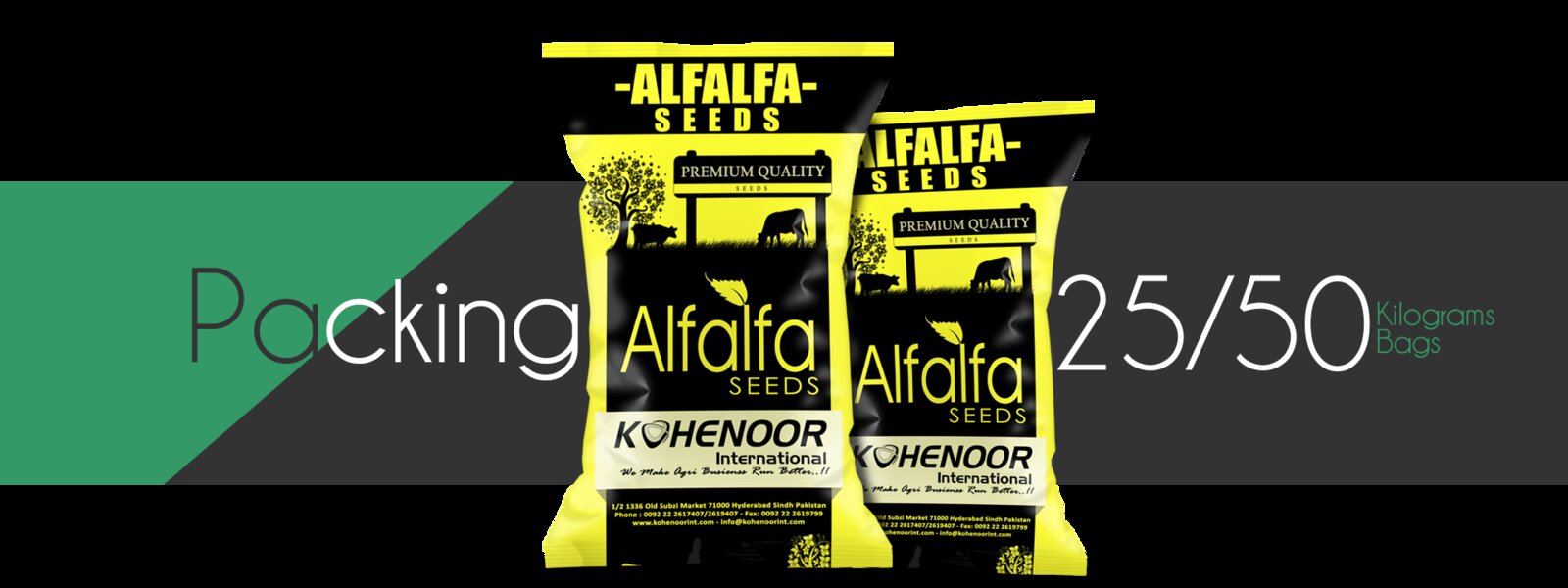
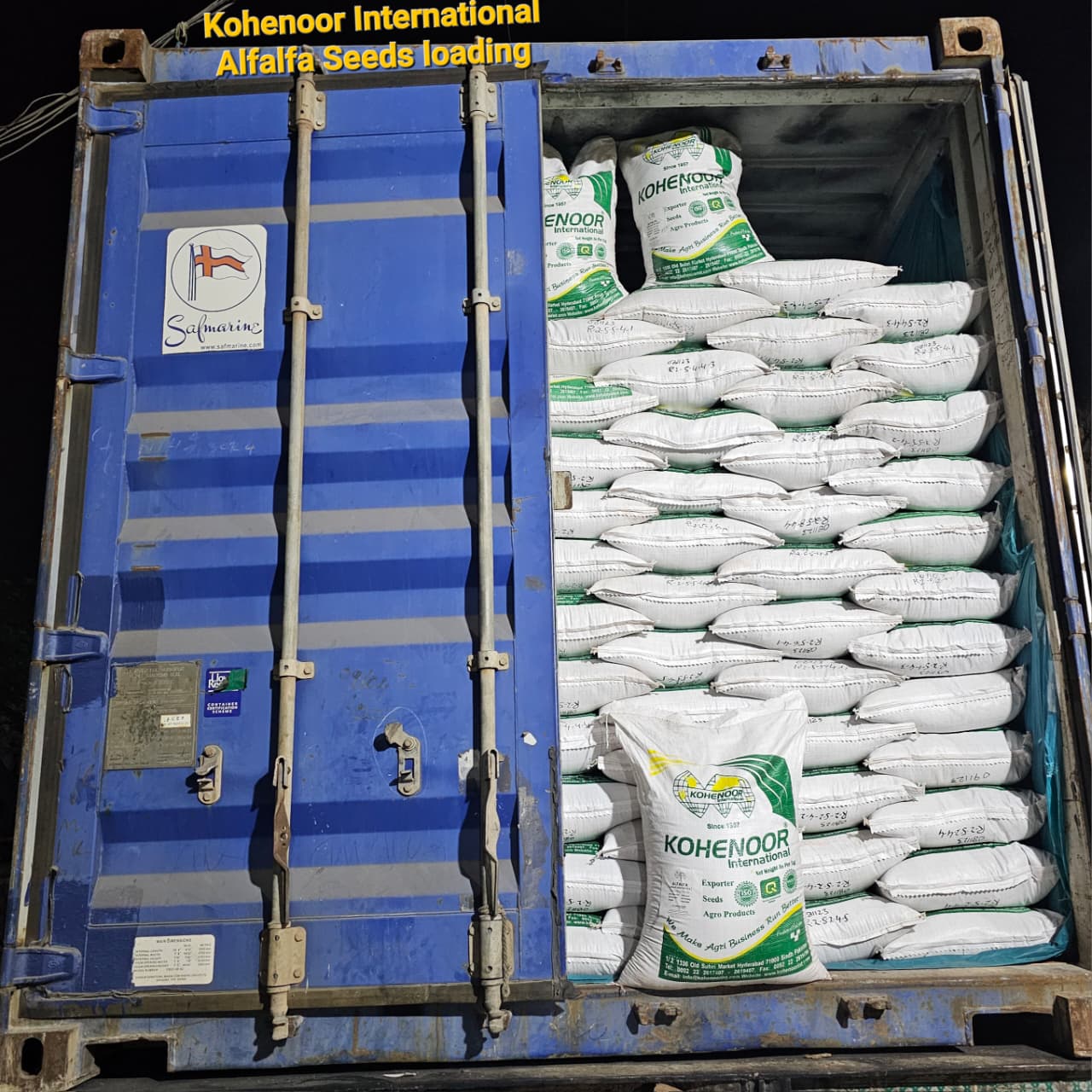
The seed behind all of this is the same: TAIZTAR, our FD10 non-dormant variety bred on modern genetics for heat and salinity, the superior replacement for the late-1970s CUF-101, and KN92, our FD9 cold-tolerant variety. Both are supplied at ≥98% purity, ≥85% germination and 0% dodder guaranteed in writing, in 25 kg lot-tagged bags, ISTA-tested per lot, with IPPC phytosanitary, ISO 9001 and HACCP documentation. Seed rate is 25–30 kg per hectare, the minimum order is 5 MT with 1 MT trial lots accepted, and in-stock lots load FOB Karachi within 7–12 days.
Kohenoor International has grown, cleaned, tested and exported Medicago sativa seed from Hyderabad, Sindh, since 1957 — three generations of one family, a research forage seed company with its own laboratory and cleaning line, ISO 9001 and HACCP certified, a member of the Australian Seed Federation, with offices in Pakistan, Dubai and Australia. The company ships direct to buyers in more than 70 countries, and the country guides now cover well over a hundred destinations. There is no dealer, agent or intermediary to find: you deal with the export desk, the seed is loaded at Karachi, and it is delivered to your port or your door under one set of documents.
Whatever word you use for the crop, the enquiry is the same three lines: quantity, destination port or city, and what the seed is for (hay, grazing, silage, a dairy ration, camel and small-ruminant forage, or sprouting). Send it by WhatsApp to +92 310 4929292 or by email to export@kohenoorint.com. The desk replies within 24 hours in English, and also in Arabic, Spanish and French, with a quotation per lot and destination, the current lot's ISTA certificate and COA, a recommendation between TAIZTAR and KN92 for your climate, and a sailing schedule. Quotations are given on WhatsApp or by email only, per lot and destination; nothing is published on the website because freight, season and lot change every week.
Useful next pages:
And if the name you need is not in the table, say so in the first message. Learning what a crop is called where you farm is part of the job.


Send the crop name as you know it, the quantity and the destination port. The export desk replies personally in English, Arabic, Spanish or French with a quotation per lot and destination, the current lot's ISTA certificate and a shipping schedule — direct from the company, no agents.
WhatsApp +92 310 4929292 export@kohenoorint.comAlfalfa is Medicago sativa everywhere, but the common name varies: lucerne in Britain and the Commonwealth; برسيم حجازي, جت or فصفصة in Arabic depending on the region; یونجه (yonjeh) in Farsi; yonca in Turkish; لوسن (lusan) in Urdu; люцерна (lyutserna) in Russian; 苜蓿 (mùxu) in Chinese; 알팔파 in Korean; アルファルファ in Japanese; luzerne in French; erba medica in Italian; lusina or alfalfa in Swahili. The full table above lists 60 languages with native script.
Yes. Lucerne and alfalfa are two names for the same species, Medicago sativa. “Alfalfa” comes from Arabic al-fasfasa through Spanish and is used in the Americas and in international trade; “lucerne” comes through French and is the word in the United Kingdom, Australia, New Zealand, South Africa and much of anglophone Africa and South Asia. There is no botanical, agronomic or nutritional difference between them.
Alfalfa seed for sowing is classified under HS code 1209.21, “lucerne (alfalfa) seed”, within heading 12.09 (seeds, fruit and spores, of a kind used for sowing) of chapter 12. The six-digit code is the same worldwide; national tariff schedules extend it to eight or ten digits and set the duty, so confirm the national tariff line with your customs broker before contracting.
Alfalfa that is not seed falls under heading 12.14. Lucerne (alfalfa) meal and pellets are 1214.10; alfalfa hay and other forage products are generally 1214.90. National schedules differ on where cubes and compressed bales sit, so confirm the national tariff line with your broker. Kohenoor exports alfalfa seed under 1209.21 and does not trade hay or meal.
It depends on the region. In Egypt, Sudan and the Levant it is برسيم حجازي (barsīm ḥijāzī, “Hijazi clover”). In the Gulf states it is جت (jatt). In Iraq, Lebanon, Syria and the Maghreb the classical word فصفصة (fiṣfiṣa) is current, and in Morocco the dialect form فصة (fessa). In Yemen you may hear قضب (qaḍb). Plain barsīm on its own means berseem, Egyptian clover, not alfalfa.
In Farsi alfalfa is یونجه (yonjeh), and alfalfa seed is بذر یونجه (bazr-e yonjeh). In Turkish it is yonca, with kaba yonca naming the cultivated species Medicago sativa. The two words share a Persian–Turkic root that also appears in Azerbaijani yonca, Tajik юнучқа and Turkmen ýorunja. In Dari and Pashto, Afghan farmers more often say rishqa or spasta.
In Nigeria there is no established Hausa, Yoruba or Igbo word for alfalfa in common use; farmers, feed millers and the agricultural ministries use the loanword alfalfa, and that is the word to search and to write on a tender. In Swahili, lusina is heard among dairy farmers in Kenya and Tanzania as a local adaptation of lucerne, but most agrovets simply say alfalfa. Both are understood.
No, and you do not need one. Kohenoor sells direct from Pakistan to buyers in more than 70 countries: you contact the export desk on WhatsApp +92 310 4929292 or export@kohenoorint.com, receive a quotation per lot and destination within 24 hours, and the seed is shipped FOB Karachi or delivered CFR/CIF to your port or door under one set of documents. One company, one contact, in English, Arabic, Spanish or French.