Lucerne seeds · Medicago sativa · since 1957

Lucerne seeds: varieties, sowing rate per acre and direct supply for Commonwealth farms

Lucerne = alfalfa (Medicago sativa) · TAIZTAR FD10 winter-active · KN92 FD9 semi-dormant · 0% dodder in writing · ≥98% purity · ≥85% germination · 25 kg bags · MOQ 5 MT (1 MT trial)

Lucerne is the name used in the United Kingdom, Ireland, Australia, New Zealand, South Africa, Kenya, Zimbabwe, Zambia and most of the Commonwealth for the crop the rest of the world calls alfalfa: the same deep-rooted perennial legume, Medicago sativa, with the same protein and the same thirst for well-drained soil. This page explains which lucerne type suits which climate, how many kilograms to sow per acre or hectare, how to establish and manage the stand, what to check before importing lucerne seed, and how Kohenoor supplies ISTA-tested, dodder-free lucerne seed direct from Pakistan to Mombasa, Durban, Felixstowe, Auckland or your port.

Get a quote in 24h
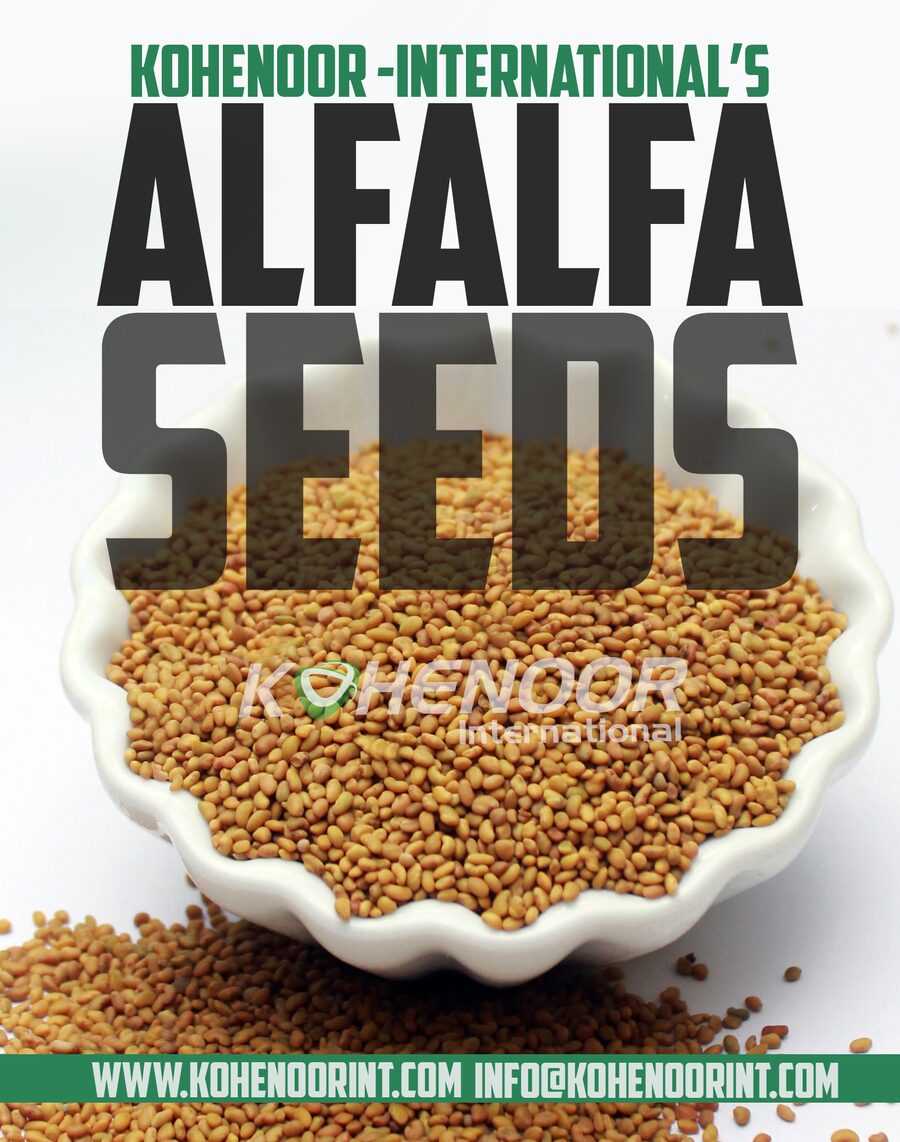
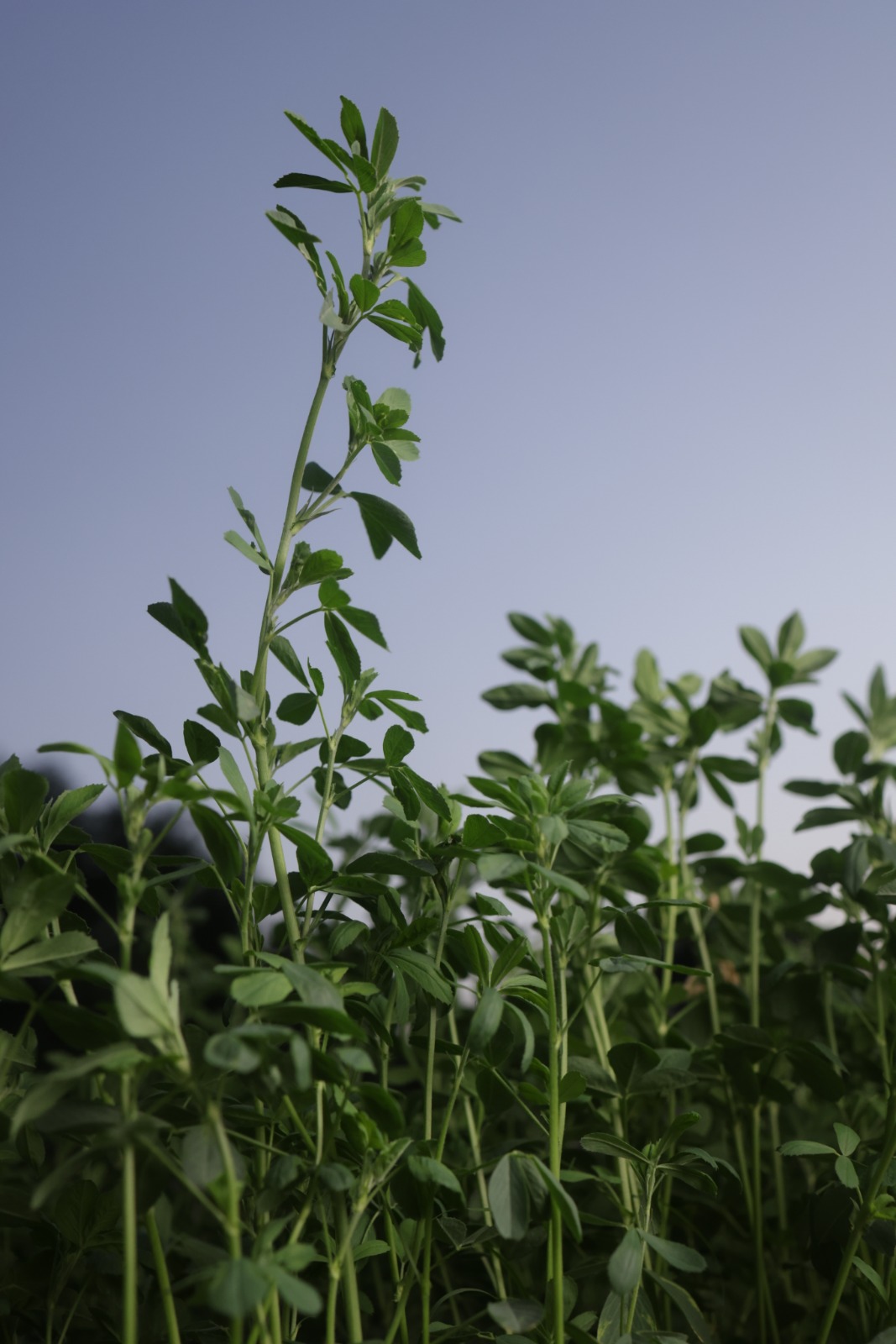
Dense lucerne stand under irrigation, the forage crop called alfalfa outside the Commonwealth
In short: Lucerne seeds and alfalfa seeds are the same product: Medicago sativa, called lucerne across the Commonwealth. Choose a winter-active type such as TAIZTAR (fall dormancy 10) for Kenya, Zambia, northern Australia and coastal South Africa, and cold-tolerant KN92 (fall dormancy 9) where frosts are regular. Sow roughly 10 to 12 kg per acre. Kohenoor supplies both direct, ISTA-certified, 0% dodder in writing.
Lucerne = alfalfa (Medicago sativa)TAIZTAR FD10 · KN92 FD90% dodder in writing≥98% purity · ≥85% germinationISTA certificate per lotDirect from the companyMOQ 5 MT · 1 MT trialSince 1957 · 70+ countries
SpeciesMedicago sativa (lucerne / alfalfa)
VarietiesTAIZTAR FD10 · KN92 FD9
Crude protein22–24%
Purity / germination≥98% / ≥85% (ISTA, per lot)
Seed rate25–30 kg/ha (10–12 kg/acre)
Packing · lead time25 kg bags · 7–12 days to FOB Karachi

Lucerne vs alfalfa: one plant, two names

Lucerne and alfalfa are the same species, Medicago sativa, a perennial legume of the pea family grown for hay, silage, grazing and green chop on every inhabited continent. The two names have different histories rather than different plants. "Lucerne" came into English from French and is the word used across the United Kingdom, Ireland, Australia, New Zealand, South Africa, Kenya, Zimbabwe, Zambia and most countries that inherited British agricultural vocabulary. "Alfalfa" came into American English from Spanish, which took it from Arabic, and is the word used in the United States, Canada, Latin America, the Gulf, the Middle East and in the international seed trade. A farmer in Canterbury buying lucerne seed and a farmer in Arizona buying alfalfa seed are buying the same crop, and a bag of Kohenoor seed can carry either word on the tag.

The confusion matters commercially because the two words live in different search results, different catalogues and sometimes different trade statistics, even though every lucerne seed is alfalfa seed under customs code HS 1209.21. A Commonwealth buyer searching for "lucerne seeds for sale" may never see the exporters who list the same seed as alfalfa, and may conclude that the only lucerne seed available is what local merchants stock. This page exists to close that gap: everything written here about lucerne seed is true of the alfalfa seed on the rest of this site, and the full list of what the crop is called in other languages is on the alfalfa names in different languages page.

What does differ between lucerne-growing regions is climate, and therefore the type of lucerne that suits them. The Commonwealth runs from the cool, wet winters of Ireland and the UK through the frost-prone highveld and South Island to the frost-free dairy belts of Kenya and Zambia. Choosing the right dormancy class is the first decision a lucerne buyer makes.

Which lucerne type suits which climate: winter-active and semi-dormant lucerne

Lucerne varieties are classified by fall dormancy, a scale from 1 to 11 describing how strongly the plant slows its growth as autumn days shorten. Australian, New Zealand and South African merchants translate the scale into words: "winter-dormant" for roughly classes 1 to 5, "semi-dormant" for 6 to 7, "winter-active" for 8 to 9 and "highly winter-active" for 10 to 11. A winter-active lucerne keeps growing through a mild winter and gives more cuts; a dormant one survives a hard winter by shutting down.

Kohenoor supplies two lucerne varieties for export. TAIZTAR is fall dormancy 10, highly winter-active, bred on modern genetics for heat and salinity tolerance as the modern replacement for CUF-101. KN92 is fall dormancy 9, winter-active but cold-tolerant, for farms where frost is a regular feature of winter. Both are supplied at ≥98% purity, ≥85% germination, 0% dodder in writing and crude protein 22 to 24% in well-managed forage. The table is general guidance as of 2026; local trial data should decide, and the export desk will say honestly if a dormant type outside our range would suit you better.

RegionTypical winterLucerne type to consider
Kenya — Rift Valley, central highlands, coastFrost-free or near frost-free; dry seasonsTAIZTAR (FD10, winter-active) under irrigation; KN92 on the highest, coldest farms
Zambia and Zimbabwe — plateau farmsDry, mild winters with occasional light frost at altitudeTAIZTAR on irrigated lowveld and most plateau; KN92 where frosts recur
South Africa — Western Cape, Northern Cape, coastal KZNMild, mostly frost-freeTAIZTAR (winter-active) for maximum cuts under irrigation
South Africa — highveld, Free State, Eastern Cape interiorRegular winter frost, cold nightsKN92 (FD9, cold-tolerant); confirm against local winter-active trials
Northern Australia — Queensland, NT irrigation areasTropical, frost-freeTAIZTAR on well-drained irrigated land
Southern Australia — Riverina, SA, WA wheatbeltCool winters, some frostKN92 where frost is regular; TAIZTAR under irrigation in milder districts
New Zealand — Canterbury, Marlborough, OtagoCold winters, frosts, dryland summersKN92 (FD9) as the warmer end of what local trials support; dormant types where winters are severe
United Kingdom and IrelandCool, wet, frost in most wintersKN92 for trial on free-draining southern and eastern sites; lucerne here is a niche crop and dormant European types are the local norm

Two cautions. A highly winter-active lucerne is less winter-hardy than a dormant one, so TAIZTAR is the wrong choice where hard frosts settle. And no lucerne of any class tolerates waterlogging, a bigger limitation than cold on many UK and New Zealand farms.

Lucerne seed sowing rate per acre and per hectare: the 25 kg bag maths

How many lucerne seeds per acre is the question every grower asks before ordering, and the honest answer is a range that depends on seed quality, sowing method and seedbed. For clean, high-germination seed drilled into a fine, firm seedbed, general guidance is 25 to 30 kg per hectare, which is roughly 10 to 12 kg per acre. Broadcast sowing, rough or saline seedbeds, dryland sowing into stored moisture and sowing late in the window push the rate to the top of the range or a little above; precision drilling of coated seed into irrigated beds can come in below it. Your agronomist or extension officer will confirm the rate for your district; the figures below are a planning tool.

Area to sowAt 10 kg/acreAt 12 kg/acre25 kg bags needed
1 acre10 kg12 kgHalf a bag; one bag covers about 2 to 2.5 acres
5 acres (about 2 ha)50 kg60 kg2 to 3 bags
10 ha (about 25 acres)250 kg300 kg10 to 12 bags
50 ha (about 124 acres)1,250 kg1,500 kg50 to 60 bags
200 ha (about 494 acres)5 MT6 MT200 to 240 bags; one container

Seed of 85% germination and 98% purity sown at these rates places far more viable seeds per square metre than the final stand keeps; lucerne thins itself to a stable population within a year or two, and the extra seed insures against uneven emergence, slugs, crusting and a dry spell after sowing. Seed of lower germination needs a higher rate for the same live seedlings, one reason a cheaper bag is rarely cheaper per established plant.

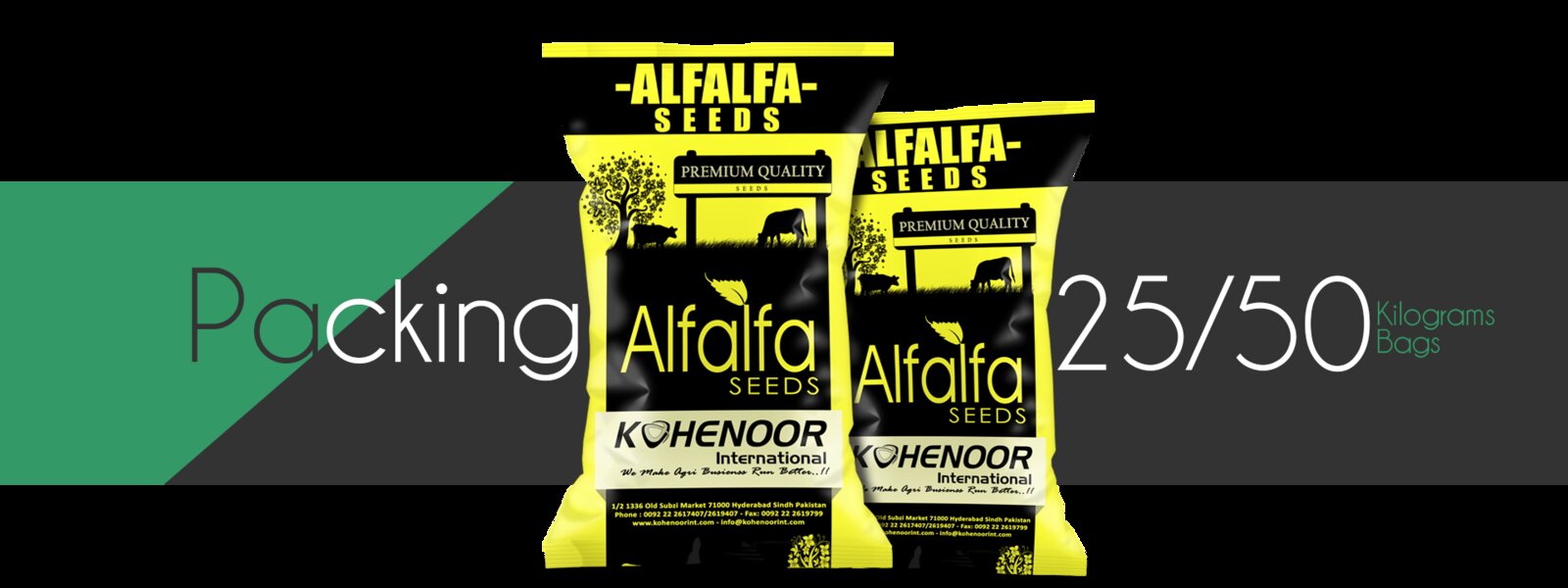
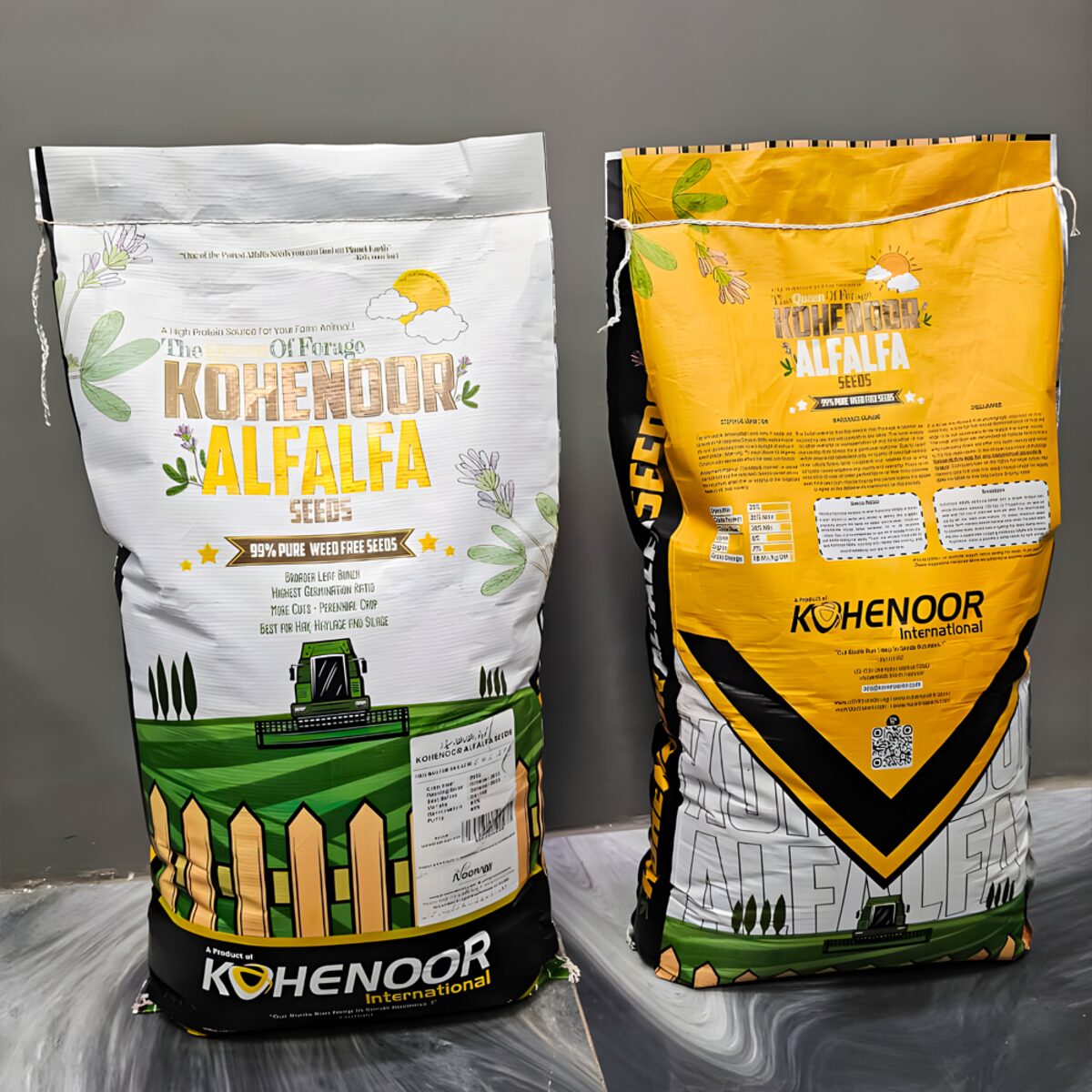
Kohenoor lucerne seed in 25 kg sealed bags with lot tags, each bag sowing roughly two to two and a half acres

Kohenoor's standard export unit is the 25 kg poly-lined bag with a sealed, printed lot tag, and the minimum export order is 5 MT, which is 200 bags, enough for about 160 to 200 hectares at normal rates. A 1 MT trial lot of 40 bags is accepted so that a farm or merchant can grow the seed beside its current lucerne for a season. For the full lot specification behind these rates see alfalfa seed specifications.

Establishing lucerne: soil pH, rhizobia inoculation, drainage and seedbed

Lucerne rewards patience at establishment and punishes shortcuts for the next five years. The principles below are general and apply from Kenya to Canterbury; the detail is local.

Soil pH and lime. Lucerne prefers a near-neutral pH, roughly 6.5 to 7.5 in water, and struggles below about 6.0 because its rhizobia do not thrive in acid soil and aluminium damages the taproot. Many Kenyan highland soils, much of the South African highveld, parts of New Zealand's hill country and most UK grassland soils need lime incorporated months before sowing. Test first; lime after the test.

Inoculation with rhizobia. Lucerne fixes nitrogen only in partnership with the specific rhizobium strain for lucerne and medics, sold as Group AL inoculant in Australia and under equivalent names elsewhere. On land that has not grown lucerne for several years the bacteria are usually absent and the seed must be inoculated at sowing, with a peat or granular inoculant applied shortly before drilling or by sowing pre-inoculated coated seed. Kohenoor supplies raw seed; inoculant is bought locally because live bacteria do not travel well and are regulated separately. Keep inoculated seed cool and sow it within the maker's stated hours.

Drainage. Lucerne's taproot can reach several metres and will not tolerate a waterlogged root zone; a stand sitting in winter water loses plants to root rot and crown disease and thins to weeds within two seasons. Free-draining soils and raised beds on heavier land matter more to lucerne than to almost any other forage, which is the principal reason it remains a niche crop on many UK and Irish farms.

Seedbed and depth. Lucerne seed is small; a fine, firm, moist seedbed with seed placed at 1 to 2 cm and pressed in gives the most even emergence. Sow into warming soil in spring in cool climates, or at the start of the main rains or the cooler irrigated season in the tropics. Control weeds before sowing; a lucerne seedling competes poorly in its first weeks. Phosphorus, potassium, sulphur, molybdenum and boron are commonly needed at establishment; a soil test decides which. A well-established stand is productive for three to five years and often longer in cool climates, so a season spent on seedbed, pH and inoculation is repaid many times.

Cutting and grazing management for lucerne

Lucerne is managed for the health of its crown and taproot, where the plant stores the energy to regrow after each cut. The general rule in every climate is to cut or graze at early bud to one-tenth bloom, when yield and protein are in the best balance, and to let the stand reach full flowering once a year so root reserves rebuild. Cutting too early and too often exhausts the crown; cutting too late gives stemmy, lower-protein forage.

Cutting interval. With a winter-active variety such as TAIZTAR under irrigation in a frost-free climate, growers plan around 25 to 35 day intervals in warm months and longer in cooler ones, which gives many cuts a year. With a cold-tolerant FD9 such as KN92 on the highveld, in Canterbury or in southern Australia, the season is shorter and the number of cuts smaller, with a long winter rest. Leave a stubble of around 5 to 7 cm, slightly more in extreme heat, so the crown is shaded and new shoots are not damaged.

Hay, silage and green chop. Lucerne leaf carries the protein, and leaf shatters when over-dry, so hay is cut in the cool of the day, raked at the right moisture and baled before the leaf falls. Lucerne silage and baleage are increasingly common in wetter climates, including the UK, Ireland and New Zealand, where field curing is unreliable. Green chop fed fresh is the norm on many African and Asian dairy farms. Well-managed lucerne from Kohenoor varieties runs around 22 to 24% crude protein in the forage.
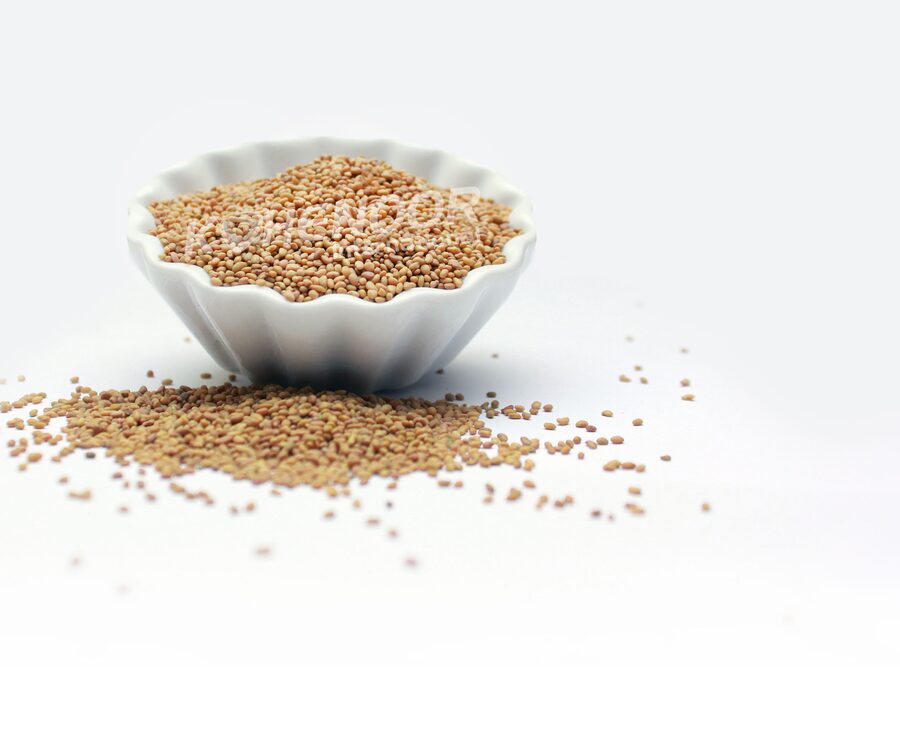
Lucerne plant at the early bud stage, the point at which growers cut for the best balance of yield and protein

Grazing. Lucerne is grazed in Australia, New Zealand, South Africa and Zimbabwe, usually in rotation with a rest of five to six weeks and stock moved before the regrowth shoots are eaten. Grazing carries a bloat risk in cattle and sheep, so stock are introduced full, with a dry fibre source and the precautions your veterinarian advises. Continuous set-stocking kills a lucerne stand quickly. Thin patches fill with weeds, so stand density is the best weed control; lucerne flea, aphids and weevils are managed regionally. Dodder, covered below, is the one pest best controlled before the seed is bought.
Dryland lucerne versus irrigated lucerne

Lucerne is grown both ways, and the two systems ask different things of the variety and the farmer. Dryland lucerne relies on stored soil moisture and rainfall, uses the taproot to reach water that shallow pastures cannot, and is managed for persistence rather than yield: fewer cuts, longer rests, a stand kept alive through a dry year rather than pushed. It is a cornerstone of New Zealand's South Island dry hill country, of southern Australia's mixed farms, of South Africa's drier summer-rainfall regions and of Zambian and Zimbabwean farms that cannot irrigate every field. Dormant and semi-dormant types are usually preferred for dryland in cool regions because they shut down in winter rather than trying to grow on no moisture; in warm dryland regions a winter-active type that uses mild-season rain can outyield them. Local trials decide.

Irrigated lucerne is the high-output system: pivot, flood or drip water through the season, a winter-active variety that converts it into many cuts, and intensive harvesting. It is how lucerne is grown on Kenya's large dairy farms around Naivasha and Nakuru, on South Africa's Northern Cape and Orange River schemes, in Australia's Riverina and northern irrigation areas, and on the irrigated schemes of Zambia and Zimbabwe. TAIZTAR was bred for this system on the Indus plains of Sindh, one of the hottest irrigated lucerne environments anywhere, where summer temperatures exceed 45 °C and irrigation water carries salt. Irrigated lucerne needs more attention to drainage, salinity and cutting schedule, and a clean seed lot more urgently, because dodder thrives in exactly the warm, moist conditions irrigated lucerne enjoys.

A farm with both irrigated and dryland blocks often uses two varieties. The export desk can quote TAIZTAR and KN92 in the same shipment, each lot with its own ISTA certificate; tell us the split when you enquire.

Dodder risk in imported lucerne seed

Field dodder (Cuscuta species) is a leafless parasitic vine whose seed is close enough to lucerne seed in size and weight to pass through ordinary cleaning, which is why it is the most common and most damaging contaminant in lucerne seed traded internationally. A single infested bag can establish a parasite that spreads outward in rings, wraps and kills the lucerne it attaches to, sets seed that survives in the soil for many years and moves to the next field on machinery. Once dodder is in a lucerne paddock there is no economic cure for the stand; the patch is destroyed and the rotation changed.

The quarantine services of the Commonwealth know this well. Dodder species are prohibited or regulated weed seeds in Australia, New Zealand, South Africa and Kenya, and a lucerne seed consignment found to contain them at the port can be rejected, treated or destroyed at the importer's cost. The UK and Ireland regulate it through seed purity standards. Buying lucerne seed from an exporter who cannot state dodder status in writing is therefore not a saving; it is an unpriced risk carried by the farmer and the importer.

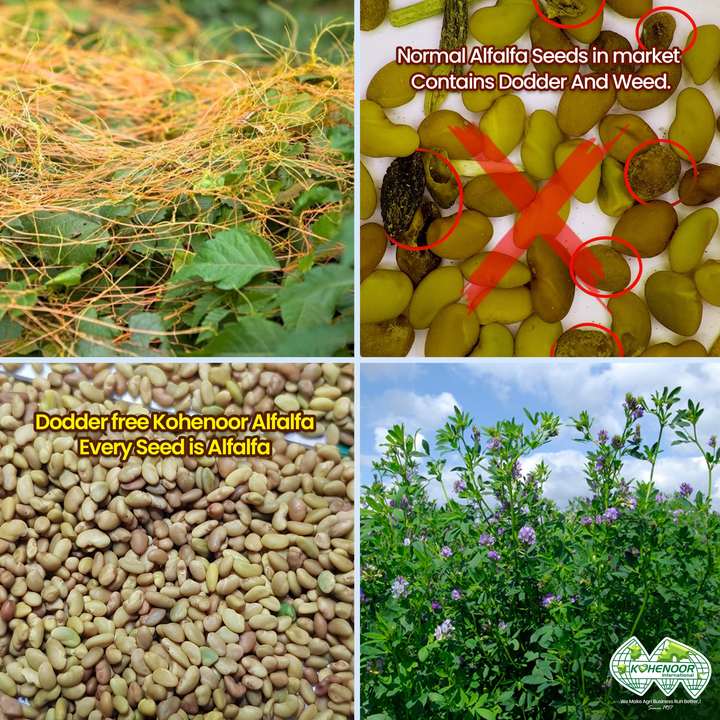
Four views of dodder, the parasitic weed whose seed must be removed from lucerne seed before export to Commonwealth markets

Kohenoor has guaranteed 0% dodder in writing on its export lucerne and alfalfa seed for decades, originally because Gulf buyers demanded it and now because every market does. The guarantee is backed by a cleaning line that runs air-screen cleaners, gravity tables and Sortex optical sorting in sequence, by ISTA laboratory testing of every lot, and by the dodder-free additional declaration on the IPPC phytosanitary certificate where your importing authority requires it. The full account, including how to inspect a lot yourself, is on the dodder-free alfalfa seeds page.

When comparing lucerne seed offers, ask three questions: does the ISTA certificate for this lot show zero dodder under "other seed"; will the phytosanitary certificate carry the dodder-free declaration my authority asks for; and does the exporter clean and test the seed itself? A supplier who answers all three in writing has removed the largest hidden cost in a lucerne seed purchase.

Importing lucerne seed into Kenya, South Africa, the UK, New Zealand and Australia

Lucerne seed is a regulated import everywhere in the Commonwealth, and the paperwork is manageable when planned before the seed is ordered. The notes below describe the usual shape of the requirements as of 2026 in general terms; rules change, and the importer must confirm current requirements with the authority named and their customs broker before shipment. Kohenoor prepares the exporting-country documents; the import permit is always the importer's.

MarketAuthority (confirm current rules)Usual requirements, in general terms
KenyaKEPHIS (Kenya Plant Health Inspectorate Service)Plant import permit obtained by the importer before shipment; phytosanitary certificate from Pakistan meeting the permit's conditions; seed variety and lot documentation; inspection and sampling at Mombasa or Nairobi.
South AfricaDALRRD (Department of Agriculture, Land Reform and Rural Development)Import permit for seed; phytosanitary certificate with any additional declarations; compliance with the Plant Improvement Act on variety and seed standards; inspection at Durban or Cape Town.
United KingdomAPHA (Animal and Plant Health Agency) and Defra seed marketing rulesPhytosanitary certificate; seed marketing rules on variety listing and certification for seed sold on; pre-notification via the import system; confirm post-2021 rules for Great Britain and separate rules for Northern Ireland.
New ZealandMPI (Ministry for Primary Industries)Import Health Standard for seed for sowing; phytosanitary certificate with specified declarations; purity testing for regulated weed seeds; possible treatment; inspection on arrival.
AustraliaDAFF biosecurity (Department of Agriculture, Fisheries and Forestry)BICON import conditions for Medicago seed; phytosanitary certificate; purity and contaminant testing; possible treatment; inspection. Kohenoor's Australian office in Officer, Victoria, assists importers.
Zambia and ZimbabwePlant quarantine services under each ministry of agricultureImport permit; phytosanitary certificate; inland routing via Durban, Beira, Walvis Bay or Dar es Salaam and border documentation.

From the Pakistan side, every Kohenoor lucerne shipment travels with an ISTA Orange Certificate for the lot, an IPPC phytosanitary certificate with the declarations your permit specifies, a certificate of origin, commercial invoice, packing list and bill of lading, under HS 1209.21. Send the export desk your import permit or your authority's conditions when you enquire and the phytosanitary application will be made to match; see export documents.

Lucerne seed terms by country: a short glossary

Buyers, merchants and agronomists in different Commonwealth countries use different words for the same seed, classes and paperwork. The table collects the terms the export desk hears most often.

Term you may hearWhereWhat it means
Lucerne, lucerne seed, lucerne hayUK, Ireland, Australia, NZ, South Africa, Kenya, Zambia, ZimbabweAlfalfa; Medicago sativa; HS 1209.21
Alfalfa, alfalfa seedUSA, Canada, Latin America, Gulf, Middle East, international tradeLucerne; the same species
Lusern, lusernsaadSouth Africa (Afrikaans)Lucerne, lucerne seed
Winter-active / highly winter-activeAustralia, NZ, South AfricaFall dormancy roughly 8 to 11; TAIZTAR (FD10) is highly winter-active
Semi-dormant / semi winter-activeAustralia, NZ, South AfricaFall dormancy roughly 6 to 7; KN92 (FD9) sits at the winter-active edge, cold-tolerant
Winter-dormantAustralia, NZ, UKFall dormancy roughly 1 to 5; the European and northern US hay types
Fall dormancy (FD) classInternational breeding and tradeThe 1 to 11 scale behind all of the above
Certified seed, Basic, C1, C2UK, Ireland, Europe (OECD scheme)Generations of certified seed of a listed variety
ISTA Orange CertificateEverywhereInternational seed testing certificate for the lot: purity, germination, other seed
Phyto, phytosanitary certificateEverywherePlant health certificate issued by the exporting country under the IPPC
Bare seed / raw seedAustralia, NZ, South AfricaUncoated seed; the form Kohenoor exports; inoculate locally
Coated seed, pelleted seedAustralia, NZ, UKSeed with lime or polymer coating, often pre-inoculated; heavier per seed
Group AL inoculantAustralia, NZThe rhizobium strain for lucerne and medics
Dodder, CuscutaEverywhereThe parasitic weed; a prohibited or regulated seed in Commonwealth imports

Outside English the crop is luzerne in French and German, erba medica in Italian, barsim hijazi in Arabic, and lusan, rijka or baramasi in Pakistan; the complete list is on the alfalfa names in different languages page.

Lucerne seed price, supply and how Kohenoor delivers direct

There is no single lucerne seed price any more than there is a single alfalfa seed price. The figure depends on variety and dormancy class, purity and germination, dodder status, raw or coated seed, lot size, season and above all the Incoterm: FOB Karachi, CFR to your port or CIF with insurance are three different figures for the same bags. Kohenoor quotes each lot and destination individually, in writing, within 24 hours. How a quotation is built and how to compare two correctly is on the alfalfa seed price page, and applies word for word to lucerne.

What Kohenoor does publish is how the supply works. The company has grown, cleaned, tested and exported lucerne seed from Pakistan since 1957, supplies more than 70 countries from its head office in Hyderabad, Sindh, with a second station at Khanewal, Punjab, and offices in Dubai and Officer, Victoria. It is ISO 9001 and HACCP certified and a member of the Australian Seed Federation. It supplies direct: no agent or distributor between the field and your port, one export desk contact from enquiry to delivery. More on the lucerne seeds supplier page.

To enquire: send your country and port, hectares or acres, sowing month, winter conditions and quantity in metric tonnes or 25 kg bags by WhatsApp to +92 310 4929292 or email export@kohenoorint.com. The desk replies within 24 hours with a TAIZTAR or KN92 recommendation, a line-by-line quotation, the current ISTA certificate and a sailing schedule. Pages for Kenya, South Africa, Zambia and Zimbabwe, and all countries, carry local sowing windows and import notes.

Lucerne seed from Kohenoor: the stand, the seed and the shipment

Lucerne seed by country

Lucerne seed for Kenya
Lucerne seed for KenyaWinter-active lucerne for Naivasha, Nakuru and the Rift Valley dairy belt, KEPHIS import notes and Mombasa shipping.
Read the Kenya page →
Lucerne seed for South Africa
Lucerne seed for South AfricaTypes for the Western Cape, highveld and Northern Cape irrigation schemes, Durban and Cape Town routing.
Read the South Africa page →
Lucerne seed for Zambia
Lucerne seed for ZambiaDryland and irrigated lucerne for Zambian commercial farms and dairies, via Durban, Beira or Dar es Salaam.
Read the Zambia page →
Lucerne seed for Zimbabwe
Lucerne seed for ZimbabweLucerne for Mashonaland dairies and irrigated schemes, import permit notes and inland routing.
Read the Zimbabwe page →

Tell us your country and your winter — we will tell you the lucerne type

Send your location, hectares or acres, sowing month and destination port. The export desk replies within 24 hours with a TAIZTAR or KN92 recommendation, a quotation for the lot and port, the current ISTA certificate and a sailing schedule — direct from the company, no agents.

export@kohenoorint.com

Frequently asked questions

Are lucerne seeds and alfalfa seeds the same thing?

Yes. Lucerne and alfalfa are two names for one species, Medicago sativa. Lucerne is the word used in the United Kingdom, Ireland, Australia, New Zealand, South Africa, Kenya, Zambia, Zimbabwe and most of the Commonwealth; alfalfa is used in the Americas, the Gulf, the Middle East and the international seed trade. Both are traded under HS code 1209.21 and a Kohenoor bag can carry either name.

How many lucerne seeds do I sow per acre?

General guidance for clean, high-germination lucerne seed drilled into a fine, firm seedbed is about 10 to 12 kg per acre, or 25 to 30 kg per hectare, so one 25 kg bag covers roughly two to two and a half acres. Broadcast sowing, rough or saline seedbeds and dryland sowing push the rate to the top of the range. Confirm the rate with your agronomist and check the lot's germination on its ISTA certificate.

What is the lucerne seeds price for a 25 kg bag?

No single figure exists, because the quotation depends on variety and dormancy class, purity, germination, dodder status, lot size, season and Incoterm: FOB Karachi, CFR or CIF to your port are different figures for the same bag. Kohenoor quotes each lot and destination individually on WhatsApp +92 310 4929292 or email within 24 hours, with the ISTA certificate attached so that offers can be compared.

Which lucerne variety is best for Kenya?

Most Kenyan lucerne is grown under irrigation on frost-free or near frost-free farms in the Rift Valley and central highlands, where a highly winter-active variety such as TAIZTAR (fall dormancy 10) gives the most cuts per year. On the highest, coldest farms KN92 (fall dormancy 9, cold-tolerant) is the safer choice. KEPHIS import permit conditions should be confirmed before shipment; the export desk prepares the matching phytosanitary certificate.

Which lucerne type suits South Africa, Australia and New Zealand?

It depends on the winter. Frost-free regions such as the Western Cape coast, coastal KwaZulu-Natal and northern Australian irrigation areas suit TAIZTAR, highly winter-active. Regions with regular frost such as the highveld, the Riverina and Canterbury suit KN92, a cold-tolerant fall dormancy 9, or a more dormant type where winters are severe. Local trial data from your extension service should confirm the choice.

Do I need to inoculate lucerne seed?

On land that has not grown lucerne or medics for several years, yes. Lucerne fixes nitrogen only with its specific rhizobium strain, sold as Group AL inoculant in Australia and under equivalent names elsewhere, applied to the seed shortly before sowing or supplied as pre-inoculated coated seed. Kohenoor exports raw seed; buy inoculant locally because live bacteria do not ship well and are regulated separately, and keep the inoculated seed cool.

Is imported lucerne seed a dodder risk?

It can be. Dodder (Cuscuta) seed is close to lucerne seed in size and weight and passes through ordinary cleaning, and it is a prohibited or regulated weed seed in Australia, New Zealand, South Africa and Kenya, so a contaminated consignment can be rejected at the port. Kohenoor guarantees 0% dodder in writing, backed by gravity and optical sorting, ISTA testing of every lot and the dodder-free declaration on the phytosanitary certificate.

How does Kohenoor supply lucerne seed to Commonwealth countries?

Direct from the company, with no agent or distributor in between. Minimum order is 5 MT, with a 1 MT trial lot accepted; in-stock lots load FOB Karachi within 7 to 12 days, or CFR/CIF to Mombasa, Durban, UK, Australian or New Zealand ports. Every lot ships with an ISTA Orange Certificate and phytosanitary certificate in 25 kg lot-tagged bags. WhatsApp +92 310 4929292 or email export@kohenoorint.com for a quotation within 24 hours.

Related pages

WA