The Kohenoor brand · alfalfa & lucerne seed · since 1957

Kohenoor alfalfa seeds: the official page for the Kohenoor (Kohinoor) alfalfa and lucerne seed brand

KOHENOOR International · Hyderabad, Sindh · TAIZTAR FD10 & KN92 FD9 · ≥98% purity · ≥85% germination · 0% dodder in writing · ISTA certificate per lot

Kohenoor, often written Kohinoor, is the alfalfa seed brand of a third-generation Pakistani seed company that has grown, cleaned and exported forage seed since 1957. This page sets out who makes it, the two varieties that carry the name, what every lot is guaranteed to meet, how to recognise a genuine bag and where to buy it direct from the company, whether you import by the container or farm a few acres in Pakistan.

Get a quote in 24h
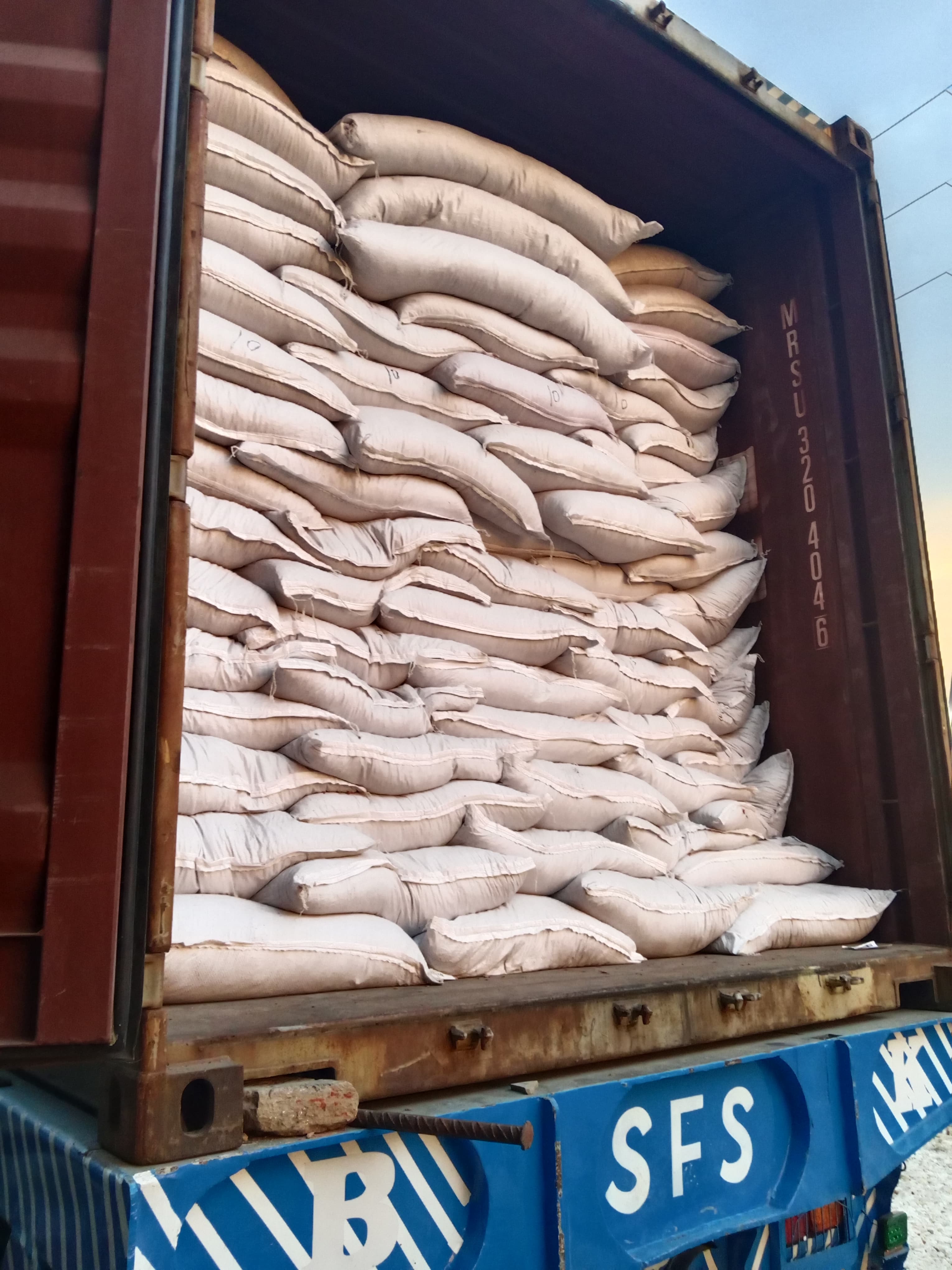
Kohenoor alfalfa seed export bags with sealed lot tags, the genuine Kohenoor brand packing
In short: Kohenoor alfalfa seeds are the alfalfa (lucerne) seed brand of KOHENOOR International, a third-generation family seed company founded in 1957 in Hyderabad, Sindh, Pakistan. Two varieties carry the brand, TAIZTAR (FD10, non-dormant) and KN92 (FD9, cold-tolerant), both supplied at ≥98% purity, ≥85% germination and 0% dodder in writing. Kohinoor is a spelling variant; Noorani Seeds is the domestic Pakistani brand.
Since 1957 · third generationHead office Hyderabad, SindhISTA Orange Certificate per lot0% dodder in writing≥98% purity · ≥85% germinationISO 9001 · HACCPAustralian Seed Federation memberDirect from the company · reply within 24 h
Kohenoor alfalfa seed at a glance
Brand ownerKOHENOOR International, est. 1957, Hyderabad, Sindh, Pakistan (also written Kohinoor; domestic brand Noorani Seeds)
VarietiesTAIZTAR (FD10, non-dormant, heat and salinity tolerant) and KN92 (FD9, cold-tolerant)
Crude protein22–24% (crude fibre up to 28%)
Purity / germination≥98% / ≥85%, ISTA Orange Certificate per export lot
Dodder0%, guaranteed in writing
Packing25 kg export bags, HS 1209.21, MOQ 5 MT (1 MT trial); domestic Noorani Seeds packs 1, 5 and 10 kg

What “Kohenoor alfalfa seeds” means, and why the name is spelt two ways

Kohenoor alfalfa seeds are the alfalfa seed sold under the Kohenoor brand by KOHENOOR International, a family seed company from Hyderabad in Sindh, Pakistan. In most of the world the crop is called alfalfa; in Pakistan, Australia, South Africa and the United Kingdom the same plant, Medicago sativa, is called lucerne, which is why buyers search for both “Kohenoor alfalfa seeds” and “Kohenoor lucerne seed” and arrive at the same product. This page is the company's own page for the brand: who stands behind it, which two varieties carry it, what every lot is guaranteed to meet, how a genuine bag is recognised and where it can be bought without an intermediary.

The spelling causes constant confusion, so it is worth settling first. The company writes its name Kohenoor, with an e. The word itself is the Persian and Urdu “koh-i-noor”, mountain of light, the name of the famous diamond, and in English it is usually written Kohinoor. Farmers, importers and marketplace listings therefore write “Kohinoor alfalfa seeds”, “Kohinoor seeds” or “Kohinoor lucerne” at least as often as the registered spelling. They mean the same brand.

Two more names belong to the same family. KOHENOOR International is the exporting company, the name on export documents, ISTA certificates and phytosanitary paperwork. Noorani Seeds is the domestic brand under which the same research and processing operation sells forage seed to farmers inside Pakistan, in smaller packs through the Pakistan line described below. A Pakistani farmer may know the product as Kohenoor lucerne from Noorani Seeds; a buyer in the Gulf or Latin America knows it as Kohenoor alfalfa seed from KOHENOOR International. The seed, the cleaning line and the laboratory are the same.

What the brand is not is a generic grade. “Kohenoor alfalfa” does not describe any heat-tolerant alfalfa from Pakistan; it describes two named varieties, TAIZTAR and KN92, grown, cleaned and tested by one company to one written specification. The rest of this page explains that specification and the company behind it. For the broader story of the exporter, see About Kohenoor International and Why Kohenoor.

Who makes Kohenoor alfalfa seed: KOHENOOR International since 1957

KOHENOOR International was founded in 1957 in Hyderabad, Sindh, as a forage seed business serving the irrigated farms of the lower Indus plain, and it is still run by the founding family, now in its third generation. Sindh is one of the hottest alfalfa environments anywhere: summer temperatures regularly pass 45 °C, irrigation comes from a canal system that carries salt, and winters are mild enough that a dormant variety never earns its place.

The head office remains at Old Subzi Market in Hyderabad, where the export desk, the laboratory sampling and the final dispatch are managed. Seed multiplication and processing are concentrated in the Khanewal belt of southern Punjab, the heart of Pakistan's fodder-seed country, where the cleaning line of air-screen cleaners, gravity tables and optical sorting prepares each export lot. Two overseas offices support buyers: one in Dubai, serving the Gulf and the wider Middle East and Africa, and one in Australia, where the company is a member of the Australian Seed Federation. From these bases the company has supplied forage and sprouting seed to buyers in more than seventy countries.

Kohenoor alfalfa seed being weighed and packed into export bags at the company's processing line

Three things have stayed constant across the generations. The first is that Kohenoor sells only what it grows or multiplies under its own control, so the name on the bag and the name on the ISTA certificate belong to the same company. The second is a refusal to ship alfalfa seed that carries dodder, the parasitic weed that ruins alfalfa stands; the written zero-dodder guarantee predates most importing countries' own quarantine rules on it. The third is direct supply: Kohenoor has never built its export business through agents or dealers, and a buyer anywhere in the world deals with the export desk in Hyderabad from the first enquiry to the bill of lading.

Alongside alfalfa the company produces Rhodes grass, berseem clover, Sesbania, sorghum, ryegrass and a range of sprouting seeds, which is why a dairy or feedlot project can source its whole forage programme from one supplier. The alfalfa brand, however, is the one most buyers know the company by, and it is the one this page is about. The full exporter profile is on the alfalfa seeds exporter page.

The two varieties sold as Kohenoor alfalfa seed: TAIZTAR FD10 and KN92 FD9

Every bag of Kohenoor alfalfa seed is one of two named varieties. Both are Medicago sativa, both are supplied to the same purity, germination and zero-dodder specification, and the difference between them is the winter they are bred for.

TAIZTAR is a fall dormancy 10 non-dormant alfalfa bred on modern genetics for heat and salinity tolerance. Fall dormancy is the 1-to-11 scale breeders use to describe how much a variety slows down as autumn days shorten; a class 10 variety keeps growing whenever temperature allows, which in a frost-free climate means the most cuts per year. TAIZTAR is positioned as the modern replacement for CUF-101, the late-1970s Californian variety that is still the default non-dormant alfalfa across the Gulf, the Middle East, the Sahel and many Latin American lowlands. Same non-dormant habit, same fit for hot irrigated systems, with four decades of breeding progress for pest resistance, salinity tolerance and stand persistence built in. Its home ground is the hot, irrigated farm that rarely or never sees frost. Full profile: TAIZTAR alfalfa seed.

KN92 is a fall dormancy 9 alfalfa that is still non-dormant enough to grow strongly through warm months but is cold-tolerant: the variety for farms where winter brings regular frost, for upland and plateau districts, and for regions where one severe cold spell every few years would damage an FD10 stand beyond recovery. Full profile: KN92 alfalfa seed.

TraitTAIZTARKN92
Fall dormancyFD 10, non-dormantFD 9, cold-tolerant
Bred forHeat, salinity, maximum cuts in frost-free climatesFrost-prone, upland and continental farms
ReplacesCUF-101 and other older non-dormant materialDormant temperate varieties that underperform in hot summers
Crude protein22–24%22–24%
Purity / germination / dodder≥98% / ≥85% / 0%≥98% / ≥85% / 0%
Seed rate25–30 kg/ha25–30 kg/ha

Choosing between them is mostly a question about the coldest night your farm records. If frost is rare, TAIZTAR; if frost is a normal part of winter, KN92; and many large farms with varied land grow both, TAIZTAR on the lowest, hottest blocks and KN92 where cold air settles. Tell the export desk your location and winter minimum and it will recommend one, with reasons.

What every lot of Kohenoor alfalfa seed is guaranteed to meet

A brand is only as good as the specification behind it, and Kohenoor's is written down and tested lot by lot. The figures below apply to both varieties and are the ones that appear on the ISTA Orange Certificate and the certificate of analysis that travel with every export shipment.

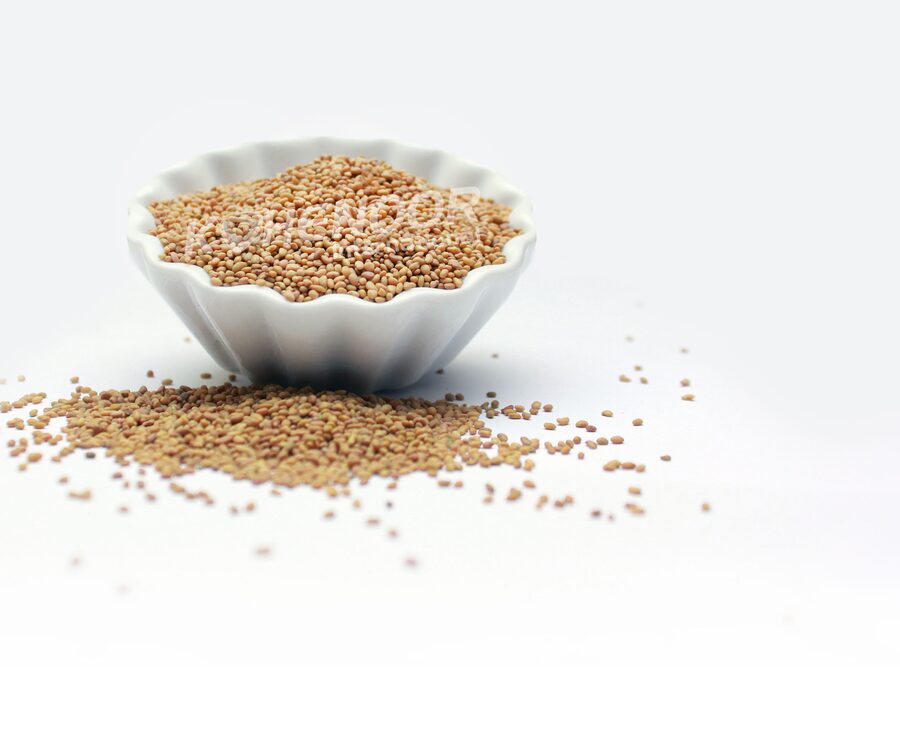
Close view of cleaned Kohenoor alfalfa seed, uniform in size and colour after optical sorting

These are minimums, not averages. Lots that test below any of them are not shipped under the brand. The specification is also the reason the company does not publish a price list on this site: a quotation is given per lot and destination, with the current certificates attached, so that the buyer is comparing a tested lot and not a headline figure. Ask on WhatsApp +92 310 4929292 or at export@kohenoorint.com and the desk replies within 24 hours.

How to recognise genuine Kohenoor alfalfa seed bags

Because the name is well known in Pakistan and the Gulf, alfalfa seed is sometimes sold as “Kohenoor” or “Kohinoor” that did not come from the company. The checks below describe, in general terms, what a genuine lot carries. They are deliberately not a reproduction of the label artwork, which changes from time to time; they are the things a buyer can verify.

Export bags. Kohenoor export alfalfa ships in 25 kg poly-lined polypropylene woven bags, sealed at the processing line. Each bag belongs to a numbered lot, and the lot number on the bag tag corresponds to the lot number on the ISTA Orange Certificate and the certificate of analysis issued for that shipment. The variety name, TAIZTAR or KN92, appears on the tag.

Domestic packs. Inside Pakistan the same seed is sold to farmers under the Noorani Seeds and Kohenoor names in smaller packs, including a 10 kg pack sized for a few acres, alongside 1 kg and 5 kg sizes. Domestic packs are branded for the Pakistani market and are sold through the company's own Pakistan line rather than through the export desk. The seed inside meets the same purity, germination and zero-dodder standard as the export lots.

What to ask for. Whoever is offering you Kohenoor alfalfa seed, ask for the lot number and the ISTA certificate for that lot. A genuine supplier can produce both; the company can confirm them. Be cautious of seed described as “Kohenoor type” or “Kohinoor quality”, of bags without a lot number, of loose seed sold by weight from an opened bag, and of any offer that cannot say whether the variety is TAIZTAR or KN92. Alfalfa seed that carries dodder looks almost identical to clean seed; the certificate, not the appearance, is what tells you.

Where the seed is made. Genuine Kohenoor alfalfa seed is grown and processed in Pakistan, with the head office in Hyderabad, Sindh and processing in the Khanewal belt of Punjab, and is exported from Karachi. Seed presented as Kohenoor but shipped from another country of origin is not the company's product. If in doubt, send a photograph of the bag and tag to the export desk on WhatsApp and it will tell you plainly whether it is ours.

Where to buy Kohenoor alfalfa seeds: two direct lines, no intermediaries

Kohenoor supplies direct from the company. There is no network of agents or dealers between the seed and the buyer, and the simplest way to be certain you are buying genuine, certified Kohenoor alfalfa seed is to buy it from the company itself. There are two lines, depending on where you farm.

Export buyers (outside Pakistan)Importers, farms and projects anywhere in the world buy from the export desk in Hyderabad. Minimum order 5 MT, with a 1 MT trial lot accepted for a first season. Stock lots load FOB Karachi within 7 to 12 days of order confirmation; CFR or CIF to your port on request. 25 kg bags, HS 1209.21, ISTA certificate per lot.

WhatsApp +92 310 4929292
export@kohenoorint.com · contact page
Farmers in PakistanGrowers inside Pakistan buy Kohenoor lucerne through the company's domestic Noorani Seeds line, in 1 kg, 5 kg and 10 kg packs with delivery across the country. Enquiries, current rates and sowing advice in Urdu are handled on the Pakistan WhatsApp line.

WhatsApp +92 326 8880000
Kohenoor Pakistan (Urdu) · Lucerne seed Pakistan

A word about online listings. You will find “Kohenoor alfalfa seeds” and “Kohinoor alfalfa seed” offered on agricultural marketplaces and by resellers, in Pakistan and occasionally abroad. Some of those listings are genuine packs bought from the company and resold; some are not. A buyer who wants a certified lot, the ISTA certificate for that lot and the written zero-dodder guarantee should buy direct, where every one of those things is part of the order.

For export buyers, what to send with the first enquiry is simple: your country and nearest port, the hectares you intend to sow, the sowing month, and whether winter frost is normal on your farm. The desk replies within 24 hours, in English, Arabic, Spanish or French, with a TAIZTAR or KN92 recommendation, the quotation for the lot and destination, the current certificates and a sailing schedule. Country-specific import notes are on the country pages, and buyers planning a large order should read the bulk alfalfa seed guide and the alfalfa seed price page, which explains what a quotation includes.

Kohenoor alfalfa seeds 10 kg and other pack sizes: the domestic Noorani Seeds line

Many of the searches that bring people to this page ask for “Kohenoor alfalfa seeds 10 kg”, and the question behind them is usually a Pakistani dairy or livestock farmer who wants to sow a few acres of lucerne. This section is for that farmer. Everything below is also explained in Urdu on the Pakistan lucerne seed page.

In Pakistan the crop is known as lucerne, losern or rajka, and Kohenoor lucerne is sold by the company's domestic brand, Noorani Seeds, from the same Hyderabad base. Packs are sized for Pakistani holdings: 1 kg for a trial plot or a kitchen-garden fodder patch, 5 kg for roughly half an acre, and the 10 kg pack, which at the recommended rate of 10 to 12 kg per acre sows close to one acre of lucerne. Larger farms buy several 10 kg packs or ask the Pakistan line about 25 kg bags.

Why does a Pakistani farmer pay attention to the brand at all? Because the most common failure of lucerne in Pakistan is not the farmer's fault. Loose, unbranded lucerne seed sold by weight in the bazaar is frequently contaminated with dodder, carries weed seed, and germinates poorly, so the stand comes up thin, is strangled by the parasite in its first year and has to be ploughed out. A 10 kg pack of certified Kohenoor lucerne sown on a level, well-prepared field in the late-September to November window, shallow, at about an inch, and fed with phosphate and potash rather than heavy nitrogen, gives a stand that is cut seven or more times a year for several years and feeds the animals the 22 to 24% protein forage that raises milk.

The Pakistan line, WhatsApp +92 326 8880000, handles pack availability, current rates and delivery across the country, and gives sowing advice in Urdu and Punjabi. Farmers should use that line rather than the export desk, which is set up for container-scale orders and international documents. The Kohenoor Pakistan hub lists the full domestic forage range, including berseem, ryegrass, Rhodes grass and the Kohenoor protein grass blend, so that a lucerne stand can be planned as part of a year-round fodder programme.

Certifications and the quality system behind the brand

Kohenoor's certifications are few, verifiable and relevant, and the company prefers to list them precisely rather than decorate the page with badges. They are these.

Beyond the certificates sit the practices that produce them. Alfalfa seed lots are cleaned in sequence on air-screen machines, gravity tables and optical sorters, and the sequence exists chiefly to remove dodder and other weed seed that are close to alfalfa in size and weight. Each lot is sampled according to ISTA rules before it is sealed, and the sample, not an assumption, decides whether the lot ships as Kohenoor. Phytosanitary inspection for the IPPC certificate is carried out by Pakistan's plant protection authority before export, with additional declarations added where the importing country asks for them.

Two things the company does not claim. It does not claim organic certification for its alfalfa seed, and it does not publish customer names or ratings: buyers in more than seventy countries have been supplied, and references for a serious enquiry are given privately, buyer to buyer, with permission. If you see a Kohenoor page or listing that carries certifications beyond the four above, it was not written by the company.

Why the zero-dodder guarantee defines the brand in export markets

Ask an alfalfa importer in Riyadh, Baghdad, Khartoum or Lima what they fear most in a container of seed and the answer is dodder. Field dodder is a leafless parasitic vine whose seed is close to alfalfa seed in size, shape and weight, which is exactly why ordinary cleaning leaves it in the bag. In the field it germinates alongside the alfalfa, attaches to the stems, draws its water and sugars from the crop and spreads outward in rings that kill the stand. Its seed survives in soil for many seasons, so one contaminated sowing can compromise a field for years, and many importing countries list it as a quarantine weed and reject or destroy lots found carrying it at the port.

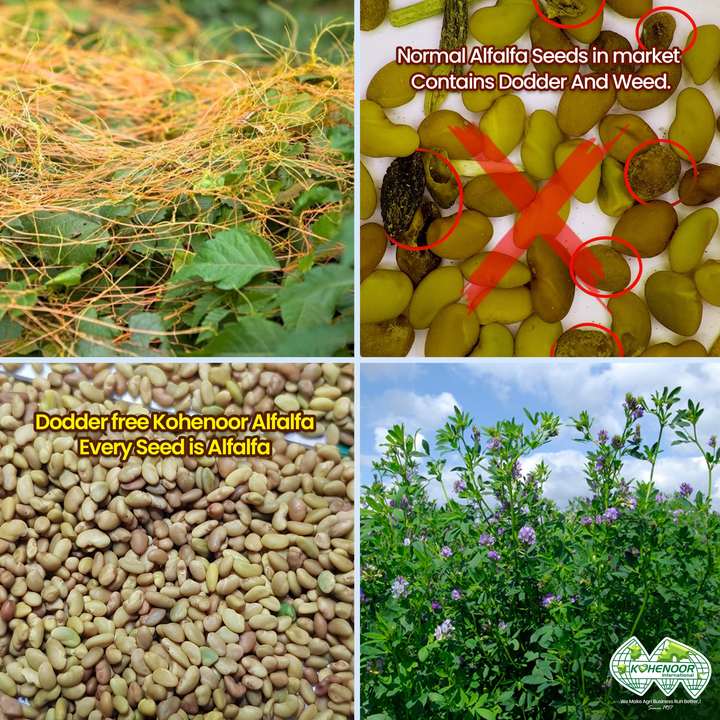
Four panels showing dodder, the parasitic weed Kohenoor alfalfa seed is cleaned to zero percent of, attacking an alfalfa stand

Kohenoor has guaranteed 0% dodder in writing on its export alfalfa for decades, originally because the Gulf markets demanded it long before most others did. The guarantee is kept by three things working together: a cleaning line whose gravity and optical stages are tuned specifically to separate dodder from alfalfa, ISTA testing of every lot with the other-seed count reported on the certificate, and the dodder-free additional declaration on the phytosanitary certificate where the importing authority requires one. It is the reason a buyer who has once lost a stand to dodder tends to specify Kohenoor by name thereafter, and the reason the brand is searched for by name rather than as a generic grade.

The guarantee is also why the company is careful about resellers and about seed sold as Kohenoor that it did not ship. A written guarantee only means something when the company that gives it has handled the lot from field to container. For the technical detail of how dodder is identified and removed, and what to ask any supplier about it, see dodder-free alfalfa seeds.

The wider Kohenoor family: sister brands, sister sites and other forage seed

Alfalfa is the seed most buyers know Kohenoor for, but it is one part of a forage and sprouting seed business that has grown over three generations. Knowing the rest of the family helps a buyer place the brand and plan a complete programme from one supplier.

Forage seed. Alongside TAIZTAR and KN92 alfalfa, the company exports Rhodes grass for hot, saline and lower-water blocks; berseem clover, the annual winter legume that partners alfalfa across Pakistan, Egypt and the Middle East; Sesbania, the fast nitrogen-fixing fodder for goats, sheep and soil improvement; forage sorghum and Sudan grass for the hottest weeks; ryegrass for winter; and a perennial super-Napier type sold domestically as Baymisaal. A dairy or camel project can therefore order its whole forage calendar in one container, and the export desk is used to assembling such orders. The dairy programme is described on the forage seeds for dairy farms page.

Sprouting seed. Kohenoor also supplies alfalfa, clover, radish, broccoli, fenugreek and other seed for sprouting and microgreens to food-grade buyers, under HACCP. Sprouting alfalfa is a different grade from forage alfalfa, with its own hygiene and testing regime, and buyers should say which they need.

Sister sites. The company maintains dedicated sites for parts of the range: kohenoorint.com for the corporate and full-catalogue view, cloverseeds.org for berseem and other clovers, sesbaniaseed.com for Sesbania, and herbnseed.com for herb and sprouting seed.

Sister brands. Noorani Seeds is the domestic Pakistani brand, and Safa Seeds appears on some domestic forage packs such as berseem and protein grass. All three names belong to the same family company in Hyderabad. When a buyer asks “is Kohenoor seeds the same company as Noorani Seeds?”, the answer is yes.

Whatever the crop, the way to buy is the same: one enquiry to the export desk on WhatsApp +92 310 4929292 or export@kohenoorint.com, a reply within 24 hours, and a direct supply from the company that grew, cleaned and certified the seed. The country guides cover import documents and sowing windows for more than a hundred destinations.
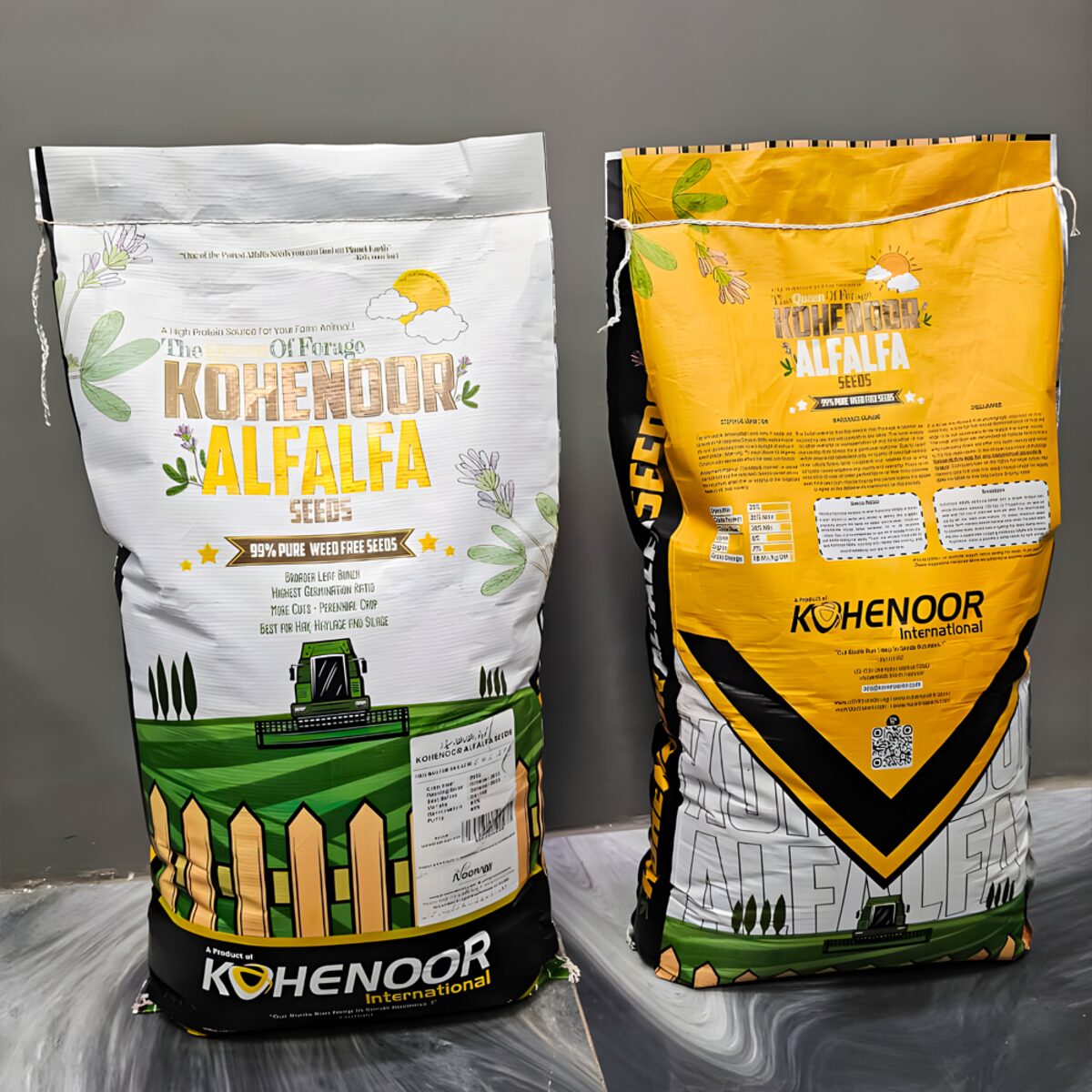
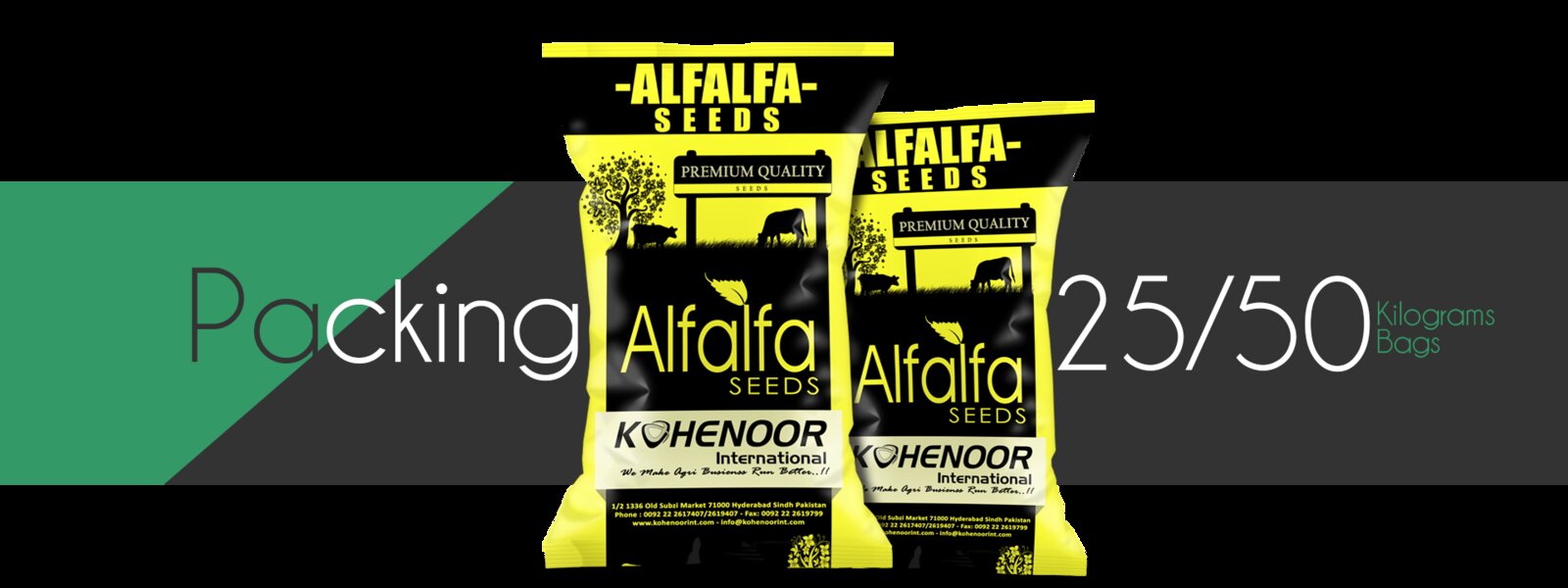
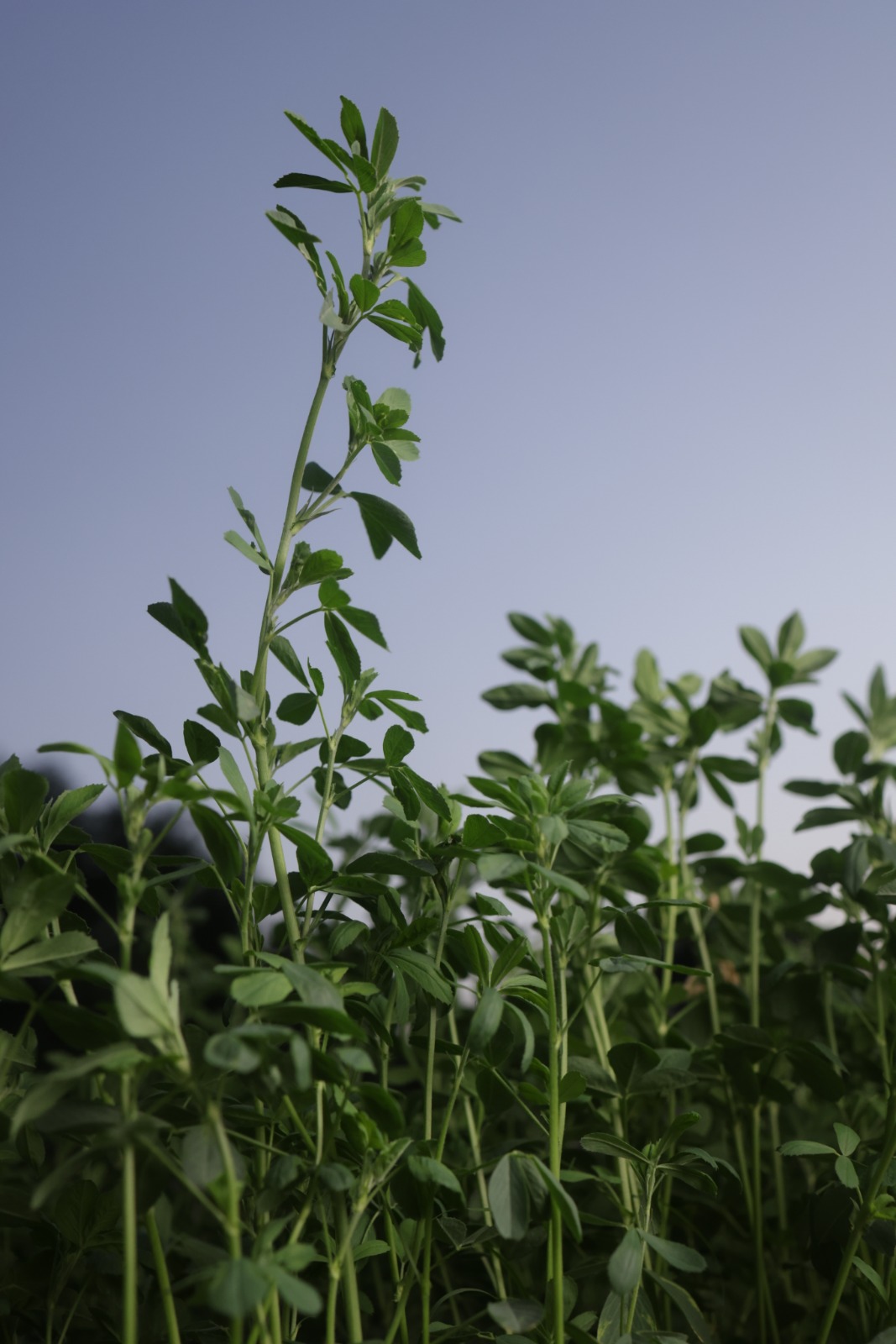
Kohenoor alfalfa seed: the bags, the seed, the field and the loading

Go deeper into the Kohenoor range

TAIZTAR alfalfa seed
TAIZTAR alfalfa seedThe FD10 non-dormant, heat and salinity tolerant Kohenoor variety that replaces CUF-101.
Variety page →
KN92 alfalfa seed
KN92 alfalfa seedThe FD9 cold-tolerant Kohenoor variety for frost-prone, upland and continental farms.
Variety page →
Dodder-free alfalfa seeds
Dodder-free alfalfa seedsHow Kohenoor keeps its written zero-dodder guarantee, lot after lot.
Read more →
Kohenoor lucerne seed in Pakistan
Kohenoor lucerne seed in PakistanNoorani Seeds domestic packs, sowing advice in Urdu and delivery across Pakistan.
Pakistan page →

Buy Kohenoor alfalfa seed direct from the company

Export buyers: send your country, port, hectares and sowing month and the export desk replies within 24 hours with a TAIZTAR or KN92 recommendation, a quotation for the lot and destination, current ISTA certificates and a sailing schedule. Farmers in Pakistan: WhatsApp the Pakistan line on +92 326 8880000.

export@kohenoorint.com

Frequently asked questions

Is Kohinoor alfalfa seed the same as Kohenoor alfalfa seed?

Yes. Kohenoor is the company's registered spelling and Kohinoor is the common English spelling of the same Urdu and Persian word, koh-i-noor, mountain of light. Farmers, importers and marketplace listings use both. Whichever spelling you were given, the product is the alfalfa seed of KOHENOOR International, Hyderabad, Pakistan, sold as the TAIZTAR or KN92 variety with an ISTA certificate for every export lot.

Who makes Kohenoor alfalfa seeds?

KOHENOOR International, a third-generation family seed company founded in 1957 with its head office in Hyderabad, Sindh, Pakistan. Seed is multiplied and processed in the Khanewal belt of Punjab and exported from Karachi, and the company has offices in Dubai and Australia. It is ISO 9001 and HACCP certified, issues an ISTA Orange Certificate per lot and is a member of the Australian Seed Federation.

Which varieties are sold as Kohenoor alfalfa seed?

Two: TAIZTAR, a fall dormancy 10 non-dormant alfalfa bred for heat and salinity tolerance and positioned as the modern replacement for CUF-101, and KN92, a fall dormancy 9 cold-tolerant alfalfa for frost-prone and upland farms. Both are supplied at a minimum of 98% purity and 85% germination with 0% dodder guaranteed in writing, and both give forage with 22 to 24% crude protein.

Do you have dealers or agents for Kohenoor alfalfa seed?

No. Kohenoor supplies direct from the company, with one contact at the export desk from enquiry to delivery, so there is no dealer or agent to find. Export buyers anywhere in the world contact WhatsApp +92 310 4929292 or export@kohenoorint.com. Farmers inside Pakistan buy the domestic Noorani Seeds packs through the company's own Pakistan line on WhatsApp +92 326 8880000, with delivery across the country.

Is Kohenoor alfalfa seed available in a 10 kg pack?

Yes, within Pakistan. The domestic Noorani Seeds line sells Kohenoor lucerne in 1 kg, 5 kg and 10 kg packs, and at the recommended 10 to 12 kg per acre a 10 kg pack sows close to one acre. Export lots ship in 25 kg bags with a minimum order of 5 MT and a 1 MT trial lot for a first season. Pakistani farmers should use the Pakistan WhatsApp line, +92 326 8880000.

How can I tell that a bag of Kohenoor alfalfa seed is genuine?

Ask for the lot number and the ISTA Orange Certificate for that lot; every genuine export bag carries a lot tag whose number matches the certificate and names the variety, TAIZTAR or KN92. Be cautious of loose seed sold by weight, bags without a lot number, seed described as Kohenoor type, or seed shipped from a country other than Pakistan. The export desk will confirm any lot number or bag photograph you send it.

Is Noorani Seeds the same company as Kohenoor?

Yes. Noorani Seeds is the domestic Pakistani brand of the same family company in Hyderabad that exports as KOHENOOR International, and Safa Seeds appears on some of its domestic forage packs. The seed, the processing line and the laboratory are shared, so Kohenoor lucerne bought from Noorani Seeds in Pakistan meets the same purity, germination and zero-dodder standard as the export lots.

What is the minimum order and lead time for Kohenoor alfalfa seed export?

The standard minimum export order is 5 MT, and a 1 MT trial lot is accepted so that a farm can grow TAIZTAR or KN92 beside its current variety for a season. Stock lots are ready for loading FOB Karachi within 7 to 12 days of order confirmation, with CFR or CIF to your port on request. Quotations are given per lot and destination on WhatsApp +92 310 4929292 or by email within 24 hours.

Related pages

WA